Majority Rules: Alternative Exterior Trim Products Reach New Milestone
By Traver Alexander, Siding & Exterior Trim Industry Analyst
The U.S. residential exterior trim market reached a significant inflection point in 2025. For the first time, alternative trim products accounted for the majority of market demand, capturing 51% of total volume and surpassing traditional wood and vinyl trim products. What was once a niche segment has evolved into the market’s largest product group, reflecting a decade-long shift toward higher-performance materials.
Traditional Products Continue to Anchor Market Demand
This market transition did not happen overnight. Since 2014, alternative trim products have been the primary growth engine within the category. Alternative trim demand increased 89% over the past decade, with its volume index rising from 100 to 189. During the same period, traditional trim demand increased just 3%, moving from an index of 100 to 103.
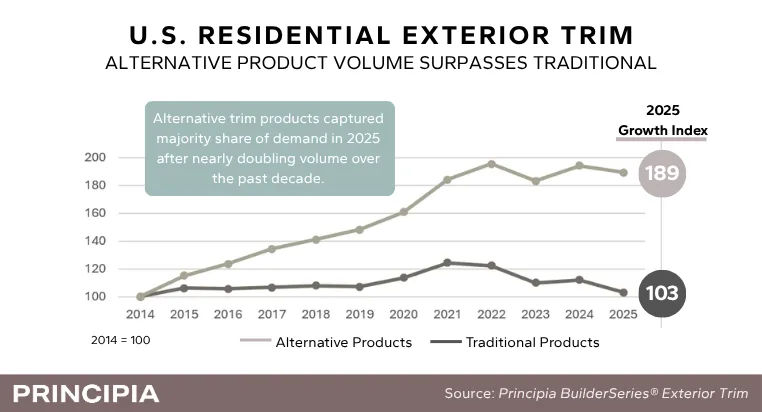
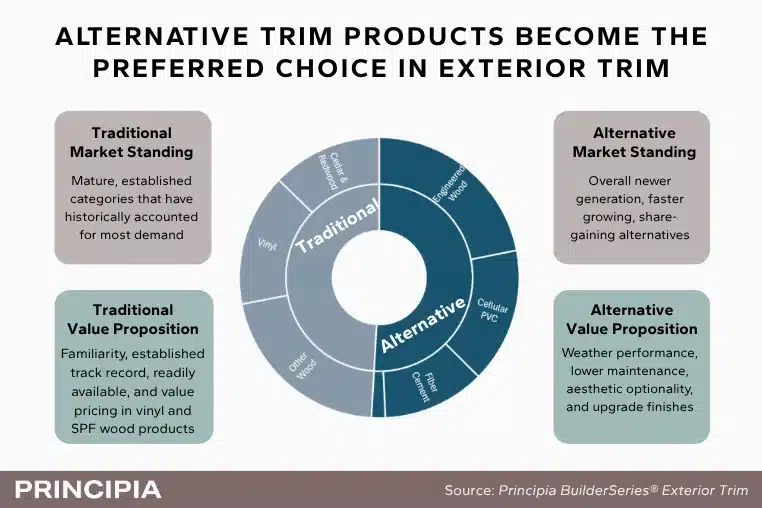
As a result, the competitive balance of the market has steadily shifted. Traditional materials such as cedar, redwood, and vinyl once represented the clear majority of demand. Today, cellular PVC, engineered wood, fiber cement, and polymer composite products collectively account for the largest share of the market.
The data also reveal that this has been a remarkably consistent trend. Alternative trim products have outperformed traditional materials every year since 2015, indicating that material substitution has become an increasingly important driver of demand.
Why Alternative Products Continue to Gain Ground
The growth of alternative trim products reflects evolving preferences among homeowners, builders, and contractors. While traditional trim materials continue to offer familiarity, established performance histories, and value-oriented price points, many alternative products provide advantages that align with current market priorities.
Alternative trim products are often selected for their weather performance, lower maintenance requirements, enhanced durability, and broader design flexibility. As homeowners seek products that reduce long-term upkeep while maintaining curb appeal, alternative materials have benefited from increasing acceptance across both new construction and remodeling applications.
The expanding availability of upgraded finishes and aesthetics has further strengthened the position of alternative products, helping them move beyond specialty applications and into mainstream residential projects
Resilience During a Slower Market
Perhaps the strongest evidence that this trend extends beyond normal housing cycles is how the two segments performed during the recent market slowdown. Following their 2022 peak, alternative trim demand declined only 3% by 2025. Traditional trim products experienced a much steeper 16% decline over the same period.
This relative resilience suggests that demand for alternative trim products is increasingly supported by ongoing market share gains rather than solely by housing activity. Even as residential construction faced headwinds, alternative products retained most of the growth achieved during the market expansion.
What This Means for the Market
The exterior trim market’s crossover point represents more than a symbolic milestone. It demonstrates that alternative trim products have transitioned from emerging substitutes into the category’s dominant demand segment.
While traditional materials continue to serve a substantial portion of the market and maintain important competitive advantages, future growth increasingly appears concentrated in alternative product categories. Manufacturers participating in cellular PVC, engineered wood, fiber cement, and composite trim are positioned within the segment that has consistently captured demand gains over the past decade.
The 2025 milestone signals a fundamental change in material preferences across residential exterior trim. As performance, durability, and maintenance considerations continue to influence product selection, the long-term shift toward alternative trim products shows little sign of slowing.
As alternative trim products establish themselves as the market’s leading segment, understanding where share gains are occurring and which products are driving growth becomes increasingly important. Principia’s BuilderSeries® Exterior Trim service provides the demand forecasting, market sizing, and competitive intelligence needed to navigate changing material preferences and capitalize on emerging growth opportunities.