Canada’s Residential Building Products Market: Where Scale Meets Growth
Principia has launched its new DemandBuilder® Canada data product. Canada building product demand data includes 18 residential categories and 5 commercial markets and is available in the same cloud-based interactive platform as Principia’s industry-leading U.S. demand data.
The Canadian market value across 18 residential building product categories totaled $24.6 billion in 2025. For context, the U.S. market value for the same categories totals $175.6 billion.
Canada’s residential building products market represents a sizable opportunity for manufacturers, but the outlook varies considerably by product category. While the largest categories account for a significant share of that value, several smaller markets are expected to grow faster over the next several years. Overall, Principia forecasts Canadian demand volume to grow at a 3.0% CAGR from 2026 through 2029. Comparatively, relatively weaker growth in U.S. new construction leaves growth in the U.S. market slightly trailing Canadian growth.
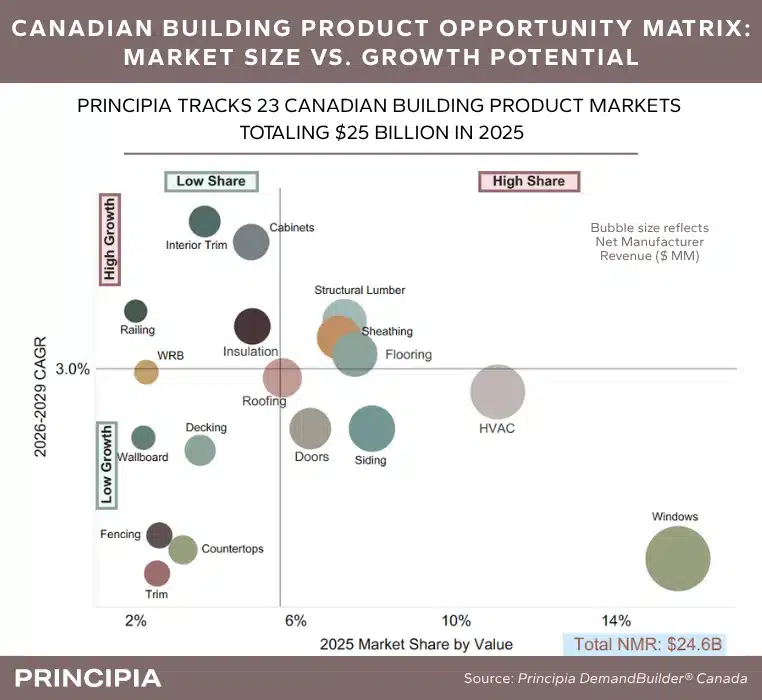
To illustrate how market size and growth potential vary across product categories, the chart below positions residential building product markets based on their 2025 share of demand value and forecast growth through 2029.
Where Scale and Growth Converge
The upper-right quadrant represents categories that combine above-average market share with above-average growth. Structural lumber, sheathing, and flooring stand out as some of the strongest opportunities in the Canadian residential market because they offer both meaningful market size and growth potential.
These categories benefit from a favorable combination of current demand and future expansion. While many markets offer either scale or growth, relatively few provide both. As a result, categories positioned in this quadrant may present the most balanced opportunity profile for manufacturers seeking participation in large and expanding demand pools.
Different Paths to Opportunity
Not all attractive markets occupy the same position in the matrix. Categories in the lower-right quadrant, including windows and HVAC, command significant shares of residential building product spending despite forecast growth rates below the market average. These markets remain important because their large installed demand bases continue to generate substantial revenue opportunities.
At the same time, the upper-left quadrant highlights categories such as cabinets, interior trim, and railing that are expected to grow faster than the overall market but currently represent smaller portions of total spending. While these categories lack the scale of larger markets, their stronger growth trajectories may create opportunities for manufacturers operating within these segments.
Together, these quadrants illustrate an important market dynamic: category attractiveness is shaped by both market size and growth potential. Large categories can remain highly valuable even when growth moderates, while smaller categories can generate compelling opportunities through above-average expansion. Understanding where a category falls within this framework provides a more complete view of future demand conditions than evaluating growth rates alone.
What This Means for the Market
Canada’s residential building products market is expected to expand over the next several years, but growth will not be distributed evenly. Manufacturers should consider looking beyond national construction trends and evaluate how market size, category growth, and demand drivers differ across their individual product portfolios.
Principia’s DemandBuilder® Canada provides category-level market sizing and forecasts designed to help manufacturers identify where demand is concentrated today and where opportunities are developing next.