What Window Manufacturers’ Capacity Moves Reveal About the Market’s Next Phase
By Traver Alexander, Windows & Doors Industry Analyst
While residential window demand remains below the highs reached during the pandemic era, manufacturers continue making significant investments in production facilities, product innovation, and manufacturing capabilities. At the same time, several companies have consolidated operations, closed facilities, or shifted production to more efficient locations.
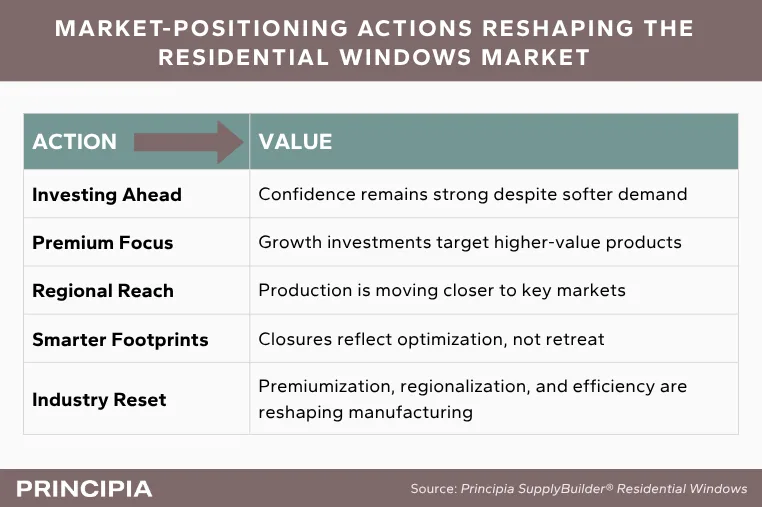
Taken together, these moves reveal an important shift occurring across the residential window industry. Rather than simply adding capacity, manufacturers are reshaping their production networks around three priorities: premium products, regional manufacturing, and operational efficiency.
Where Manufacturers Are Investing
Recent investments suggest window manufacturers are placing long-term bets on differentiated products, innovation, and strategic geographic positioning rather than broad-based capacity expansion.
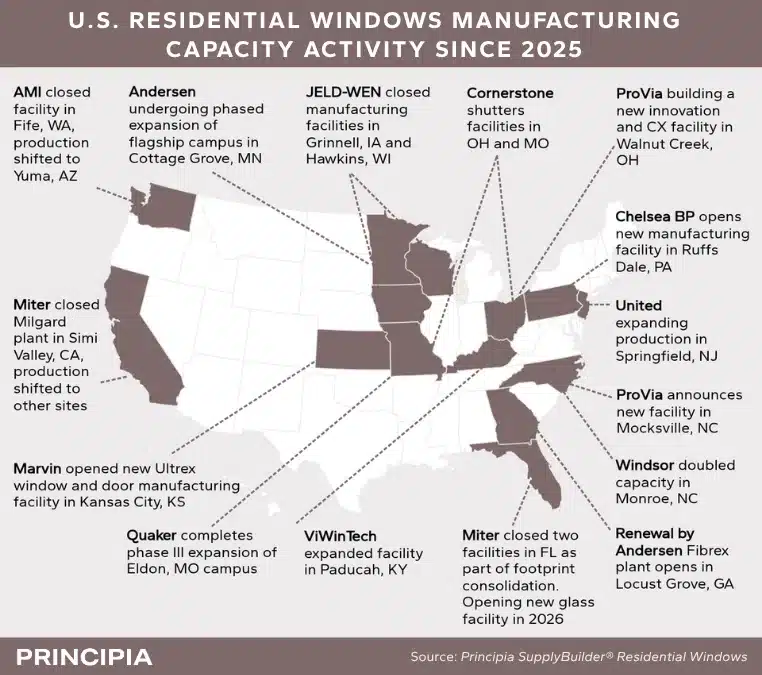
Marvin’s new Ultrex manufacturing facility in Kansas City, Renewal by Andersen’s continued expansion of Fibrex production, and ProVia’s investments in innovation and manufacturing capacity all point to a growing emphasis on higher-value products and proprietary technologies. At the same time, manufacturers such as United, Windsor, ViWinTech, and Quaker have expanded production capabilities to better support customers and strengthen regional coverage.
A clear pattern is emerging: manufacturers are increasingly locating production closer to key growth markets. Facilities in North Carolina, Georgia, Pennsylvania, and New Jersey position suppliers near large and growing residential construction and remodeling regions. This approach can reduce transportation costs, improve lead times, and provide greater flexibility as regional demand conditions change.
The result is an industry that appears increasingly focused on building manufacturing networks that support both growth and responsiveness.
Consolidation Reflects Optimization, Not Retreat
While facility closures often receive significant attention, many recent consolidation efforts appear to be driven by efficiency rather than weakening market fundamentals.
Miter Brands has consolidated facilities while simultaneously investing in new manufacturing capabilities. JELD-WEN has streamlined portions of its manufacturing footprint by shifting production into larger and more efficient operations. Associated Materials similarly reallocated production resources as part of broader operational improvement efforts.
These moves reflect a common objective: improving asset utilization, reducing complexity, and concentrating production in facilities better aligned with future demand opportunities. In many cases, manufacturers are not exiting markets but repositioning capacity to improve long-term competitiveness.
What This Means for the Market
Recent capacity announcements suggest window manufacturers are preparing for a different environment than the one that existed during the pandemic-era building boom. New investment is increasingly directed toward premium products, innovation, vertically integrated operations, and regional manufacturing networks. At the same time, underutilized facilities are being consolidated, and manufacturing footprints are being optimized for efficiency. The industry’s manufacturing strategy is no longer centered solely on producing more units. Instead, suppliers appear focused on creating networks that are more flexible, more regionally aligned, and better positioned to support profitable growth.
As residential demand gradually improves, manufacturers with the strongest combination of product differentiation, regional coverage, and operational efficiency may be best positioned to capture market share in the next phase of the cycle.
What This Means for Manufacturers
Manufacturing investments, plant closures, and production shifts often provide some of the earliest indicators of changing competitive strategy and future market direction. SupplyBuilder® helps building product manufacturers monitor supplier activity, identify emerging industry trends, and understand how manufacturing investments are reshaping competitive markets. Connect with Principia to learn how SupplyBuilder® can strengthen your market intelligence and supplier strategy.