More SKUs, More Complexity: The Growing Divide in Building Materials
SKU proliferation continues to reshape the building materials landscape—and manufacturers are at the center of that transformation. As product lines expand to meet evolving market demands, the downstream effects are being felt unevenly across the channel.
Drawing on insights from Principia’s monthly Voice of Customer surveys of dealers, builders, and contractors, the latest data reveals a growing divide: what benefits one part of the value chain is creating strain for another.
Two Realities Emerging
When asked, “How would you say the rising number of SKUs has affected your business?” respondents delivered a clear but conflicting story. Dealers and distributors are feeling increasing operational pressure, while builders and contractors are realizing tangible advantages. This divergence highlights a critical tension for manufacturers to consider as they continue to expand their portfolios.
The Dealer Perspective: Mounting Operational Complexity
Compared to our 2024 findings, an even greater share of lumberyards and one-step distributors now report that rising SKU counts are negatively impacting their business
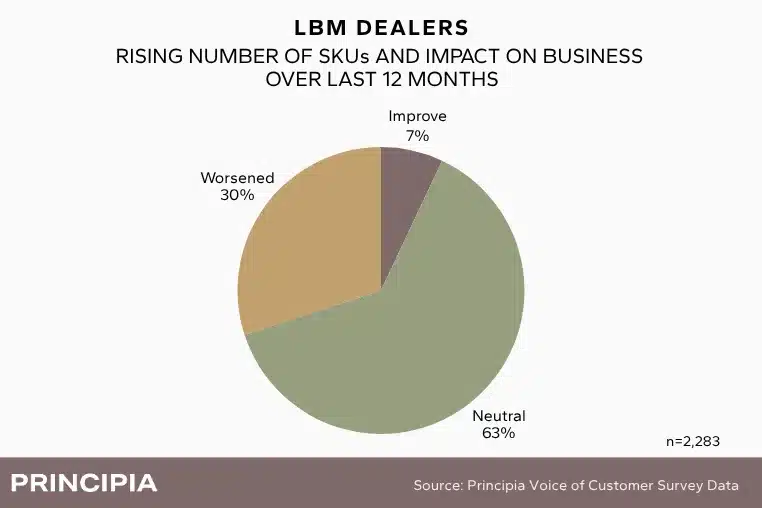
For dealers, SKU proliferation introduces cascading challenges:
- Inventory strain: More SKUs require greater warehouse capacity and working capital investment
- Forecasting risk: Predicting demand across an expanding assortment increases the likelihood of slow-moving or obsolete inventory
- Operational complexity: Managing, tracking, and merchandising a broader mix of products demands more sophisticated systems and processes
As product lines grow, dealers are being pushed to carry deeper and wider assortments—often without corresponding increases in throughput. The result is a more complex, less efficient operating environment.
The Professional Advantage: Flexibility at the Jobsite
In contrast, builders and contractors are seeing clear benefits from expanded product availability—and their sentiment has strengthened since our initial findings.
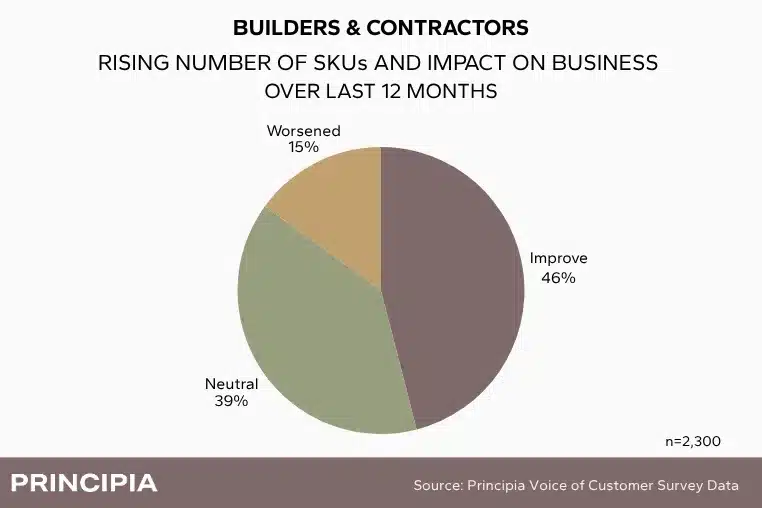
A broader SKU assortment enables:
- Greater specification flexibility to meet design and performance requirements
- Improved substitution options when products are unavailable
- Enhanced ability to manage budgets and timelines amid supply variability
For building professionals, increased SKU availability translates directly into agility. With more options at their disposal, they can keep projects moving and adapt more easily to changing conditions.
The Strategic Implication for Manufacturers
The latest data underscores a fundamental imbalance: the same SKU expansion that creates value for builders and contractors is introducing inefficiencies for dealers.
For manufacturers, this presents a strategic inflection point. Continued product line growth must be balanced with a deep understanding of channel impact:
- Are new SKUs driving incremental demand—or fragmenting existing volume?
- How can product portfolios be optimized to support dealer efficiency as well as end-user flexibility?
- What role can manufacturers play in helping channel partners manage complexity (e.g., packaging strategies, demand signals, rationalization efforts)?
For manufacturers, the path forward lies in balancing innovation and expansion with discipline—ensuring that product growth strengthens the channel rather than straining it.