Traditional Strength, Alternative Growth: What Today’s Siding Market Reveals About Future Demand
By Traver Alexander, Siding & Exterior Trim Industry Analyst
The siding market is increasingly defined by two parallel trends. Traditional materials such as vinyl, brick, stucco, masonry veneer, and natural wood continue to account for most siding demand. At the same time, alternative products including engineered wood, fiber cement, metal, and polymer composites have emerged as the industry’s primary growth drivers. Understanding the balance between these segments provides important insight into where future demand opportunities are likely to emerge.
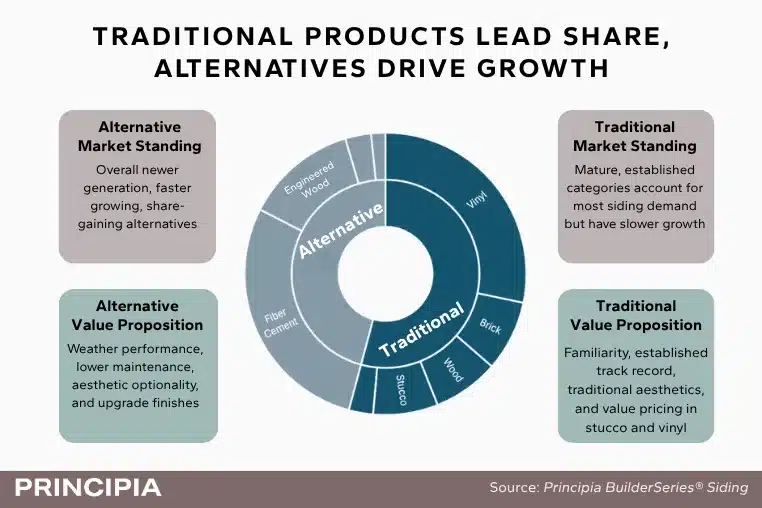
Traditional Products Continue to Anchor Market Demand
Despite increased attention on newer siding technologies, traditional products remain the largest segment of the market, accounting for 54% of siding demand. Their position is supported by extensive installed bases, long-standing contractor familiarity, established distribution networks, and widespread acceptance among homeowners and builders.
Traditional materials also benefit from a balanced demand profile. Brick, stucco, and masonry veneer have meaningful exposure to residential new construction activity, while vinyl and wood products generate substantial repair and replacement demand. This large installed base helps create recurring opportunities even during periods of slower housing activity.
Traditional products maintain a slight advantage in new construction exposure, but that lead is being challenged as engineered wood and fiber cement gain traction among builders. The result is continued share gains for alternative products across both new construction and repair and remodel applications
Alternative Products Have Become the Industry’s Growth Engine
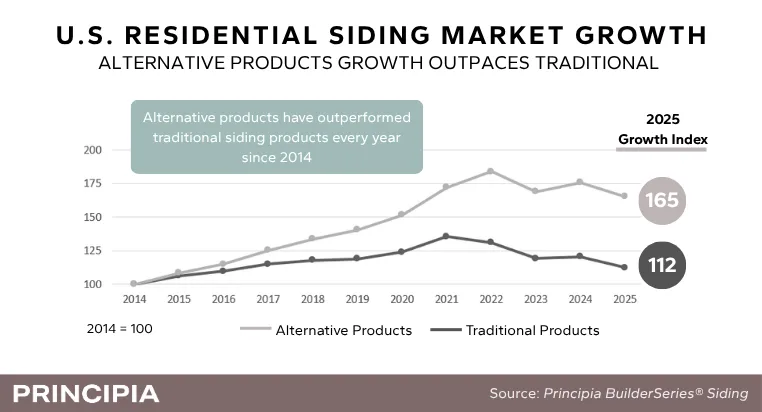
While traditional products continue to hold the largest market share, alternative siding products have emerged as the industry’s primary growth engine. Since 2014, the alternative siding volume index has increased 65%, compared to just 12% growth for traditional products. Alternative products outperformed traditional materials every year during that period, demonstrating sustained momentum across multiple market cycles.
Growth has been driven by increasing adoption of engineered wood, fiber cement, metal, and polymer composite products across both new construction and repair and remodel applications. These products continue to gain attention for their durability, lower maintenance requirements, weather performance, and expanding range of design options.
Product Substitution Is Influencing Market Share
The growth of alternative products cannot be explained by housing activity alone. Strong performance across both expansionary and slower market periods suggests that product substitution is playing an increasingly important role in shaping siding demand.
Homeowners and builders are increasingly evaluating products based on long-term performance, maintenance requirements, weather resistance, and aesthetic flexibility. As a result, alternative products have continued to gain share in applications that were once dominated by traditional materials. Even during recent market softness, alternatives retained a greater portion of their previous gains, reflecting continued upgrade-driven demand and evolving consumer preferences.
What This Means for the Market
For manufacturers, the siding market is not a story of traditional products being displaced. Rather, it reflects a market where established materials continue to benefit from scale, contractor familiarity, and replacement demand, while alternative products capture a growing share of industry growth through performance differentiation and innovation.
Traditional products remain well positioned due to their large installed base and recurring replacement opportunities. Meanwhile, alternative products are expected to continue gaining share as builders and homeowners seek durable, lower-maintenance solutions that offer greater design flexibility. Manufacturers that successfully align their product strategies with both installed-base replacement demand and evolving performance expectations will be best positioned to capitalize on future growth opportunities.
DemandBuilder® helps manufacturers quantify these trends with detailed demand forecasts and market intelligence, providing the visibility needed to navigate changing market conditions and identify future growth opportunities.