Competitive Power is Shifting in the Residential Doors Market
By Traver Alexander, Industry Analyst, Siding, Exterior Trim, Windows, Residential Doors
The U.S. residential interior and exterior doors market remains highly concentrated, but competitive power within the industry’s leadership ranks is shifting. In 2025, the four largest suppliers (CR4) generated approximately 65% of market revenue, highlighting the continued dominance of a small group of manufacturers. Beneath that stable concentration level, however, leadership dynamics have changed significantly over the past several years.
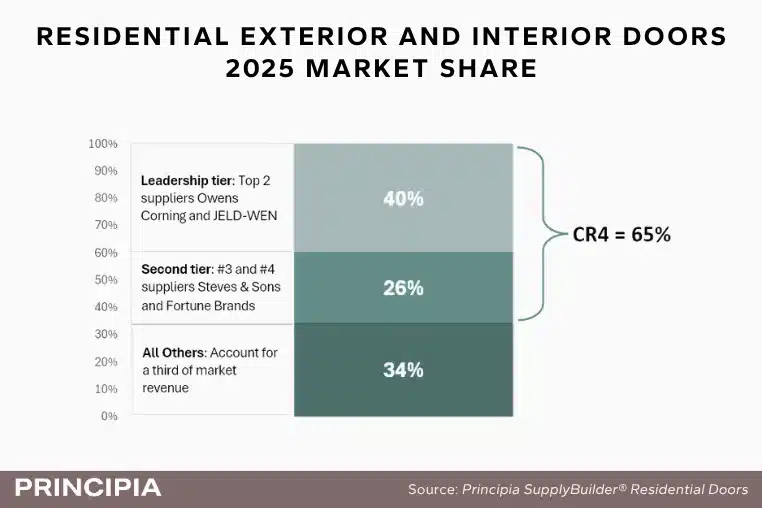
Since 2020, the combined share of the two market leaders (leadership tier) has declined from 50% to 40%, while the third- and fourth-largest suppliers (second tier) increased their share from 19% to 26%. Share held by all other manufacturers increased by roughly four share points during the same period. These shifts suggest the residential doors market is not broadly fragmenting. Rather, market share is being redistributed among leading suppliers as second-tier competitors strengthen their positions and narrow the gap with the industry’s traditional leaders.
Leadership Was Remarkably Stable Through 2023 Before Weakening Rapidly
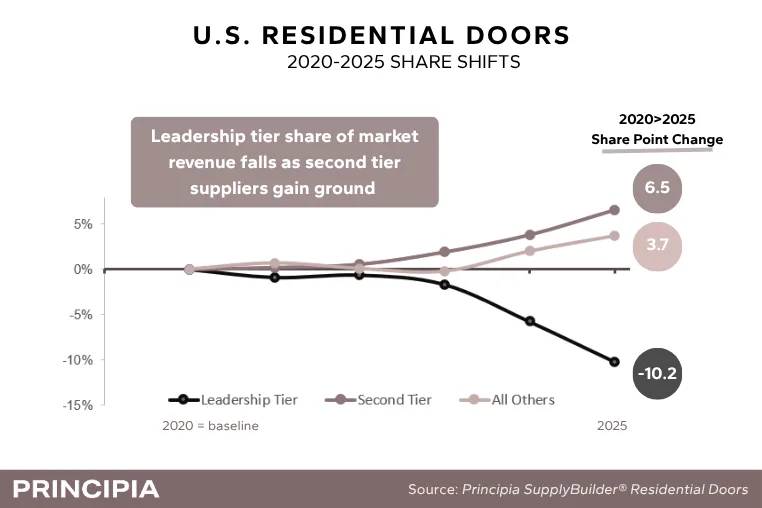
The leadership tier lost less than two share points between 2020 and 2023, but losses accelerated sharply thereafter, reaching more ten share points by 2025. The market’s competitive structure remained largely intact through the pandemic-era demand surge before undergoing a more meaningful competitive realignment in 2024 and 2025.
Second-Tier Suppliers Captured Most of the Share Lost by Market Leaders
The second tier gained 6.5 share points by 2025 relative to 2020, meaning nearly two-thirds of the leadership tier’s decline was captured by the third- and fourth-largest suppliers rather than dispersed across the broader market. This suggests competitive gains have been concentrated among established national players with the scale and resources to expand their market positions.
The Market Is Rebalancing, Not Fragmenting
While all other manufacturers gained share over the period, their gains remained smaller than those achieved by the second tier. Combined with a CR4 that remained near 65% in 2025, competitive influence continues to reside within a concentrated group of manufacturers, even as leadership positions are reshuffled.
What This Means for the Market
Although the residential doors market remains highly concentrated, the balance of competitive power is gradually shifting. Market leaders continue to hold significant influence, but second tier and regional suppliers are steadily strengthening their positions and capturing share. As these manufacturers gain scale and market presence, competition for channel relationships, specification activity, and replacement demand is intensifying across the industry. The result is a market that remains concentrated at the top while becoming increasingly competitive within its leadership ranks. For leading suppliers, maintaining growth may increasingly depend on product innovation, operational execution, and the ability to defend established market positions against a strengthening group of challengers.
Understanding how competitive dynamics are evolving requires more than tracking market share metrics. Principia’s SupplyBuilder® Doors provides detailed visibility into supplier market share, channel utilization, competitive positioning, and market structure, helping manufacturers identify growth opportunities, benchmark performance, and better understand where competitive pressures are gaining momentum.