Homebuilders Are Value-Engineering for Affordability, But Not All Products Are Equally Exposed
By Principia’s Industry Analyst Team
Affordability remains one of the biggest challenges facing the U.S. housing market. For homebuilders, the pressure is coming from both sides: buyers remain highly price sensitive, while construction costs and sales incentives continue to pressure margins.
Principia’s recent industry interviews indicate builders are responding by looking across the home for opportunities to lower costs. But this is not simply a broad shift toward cheaper building products.
Instead, value engineering is taking different forms across product categories. Builders are trading down where it makes sense, simplifying designs, reducing product quantities, and in some cases reducing home size or simplifying floor plans to lower overall construction costs, while emphasizing installation efficiency and cost. How far they can go often depends on building codes, product performance, and how visible the change is to the homeowner.
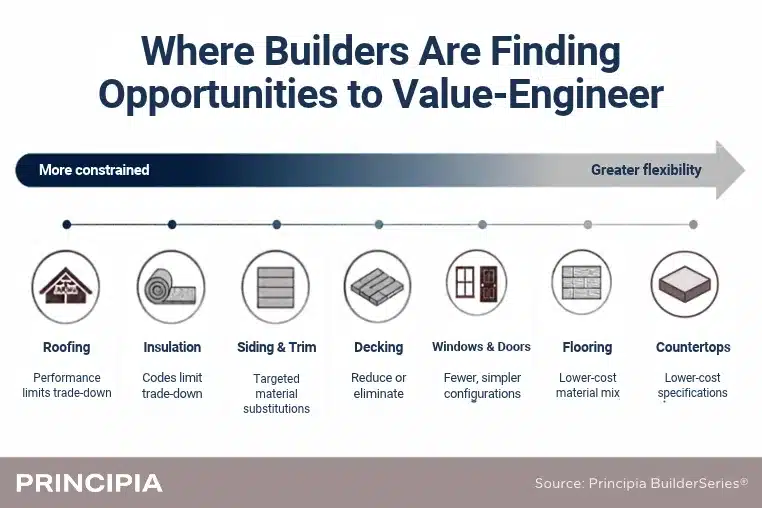
Value Engineering Looks Different Across the Home
Some building product categories provide considerably more flexibility than others.
Roofing and insulation appear relatively insulated from significant trade-down. In roofing, builders continue shifting toward higher-performance laminated shingles while three-tab shingles lose share. Insulation specifications are constrained by energy codes, although some builders are pulling enhanced packages back toward code minimums or limiting higher-cost products such as spray foam to targeted applications.
Siding and trim show a different pattern. Rather than widespread material downgrades, builders are finding targeted savings through vinyl trim and soffit substitutions, reducing masonry veneer accents, and selecting materials that can shorten installation time or reduce dependence on specialized labor.
Cost Savings Aren’t Always About Cheaper Materials
Windows, doors and decking demonstrate another important form of value engineering: using less product.
Builders are reducing window and door counts, simplifying configurations and favoring products that streamline installation. In decking, some builders are eliminating the deck from the initial build altogether, leaving homeowners to add one later. When decks are included, pressure-treated lumber and entry-level composites remain common cost-sensitive choices.
That distinction matters for manufacturers. Affordability pressure may affect demand not only through shifts in product mix, but also through lower product usage per new home.
Some Categories Have More Room to Trade Down
Traditional product trade-down is more apparent in flooring and countertops.
Builders are increasingly specifying lower-priced laminate, LVT, and sheet vinyl flooring, where improved aesthetics and faster installation have made lower-cost products viable alternatives. Countertops see similar pressure through lower-cost quartz designs, thinner slabs and, in some cases, substitution toward laminate or lower-grade quartz. Industry interviews indicate this product mix shift has contributed to declining price per square foot, creating cases where suppliers have increased volume without comparable revenue growth.
What This Means for the Market
Builder value engineering is not simply a race toward the lowest-priced product. Products supported by code requirements, differentiated performance, installation efficiencies or visible consumer value may be better positioned to defend their place in the home.
For other categories, affordability pressures could reshape demand through material substitution, simplified specifications, fewer units per home, and floor plan decisions that reduce the amount of product required in each home. For building product manufacturers, understanding both how much is being built and how product usage within each home is changing will be increasingly important to anticipating market demand.
Principia’s DemandBuilder® market data helps manufacturers track how changes in construction activity, product usage and market mix translate into demand across building product categories.