Market-Wide Efficiency Shift: How the HVAC Landscape Has Changed
The HVAC market is in the middle of a major efficiency upgrade. Regulations are tightening, technology is advancing fast, and a big wave of older systems are aging out. Together, these trends are pushing both residential and commercial customers toward smarter, cleaner, and more efficient equipment.
What’s Driving the Shift
- Efficiency is now a must-have. Since 2014, demand for high‑efficiency systems has steadily climbed. New standards, utility incentives, and rising energy costs are making efficient equipment the default—not an upgrade.
- Aging systems hitting the end of their lifecycle. With HVAC average lifespan 15–20 years, many pre‑2014 units are now due for replacement. Most of today’s replacements are high‑efficiency models designed to meet new DOE and EPA requirements.
- High-growth segments leading the charge. Smart HVAC controls continue to see standout growth, with more owners prioritizing automation and energy monitoring. VRF heat pump systems, often delivering notably higher efficiency, are also gaining traction across commercial buildings.
These fast-moving segments are reshaping demand patterns in a way that didn’t exist a decade ago.
HVAC Market: Then vs. Now (2014 → 2026)
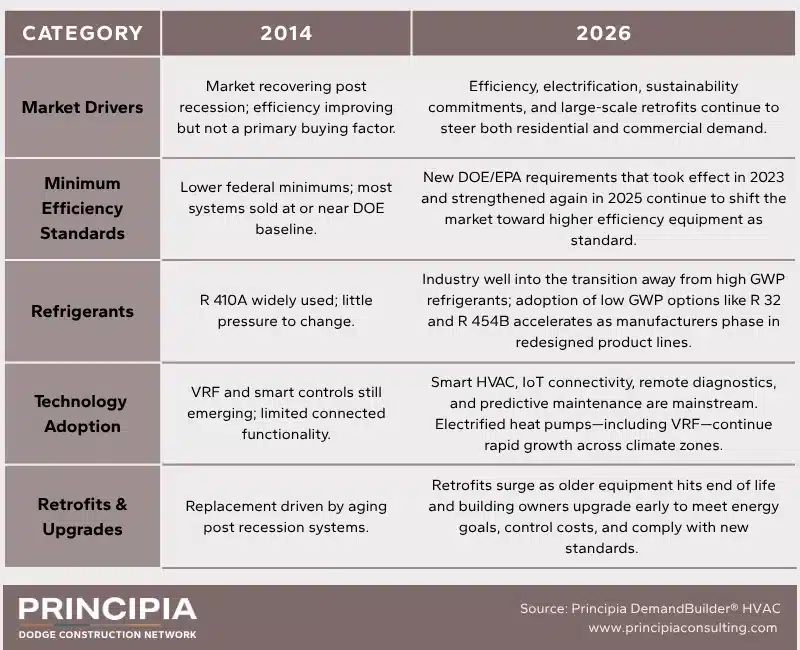
The HVAC market is undergoing its biggest shift in more than a decade. While both residential and commercial markets are moving toward higher efficiency and electrification, the residential market is being reshaped more by aging system replacements and consumer-focused energy savings, whereas the commercial market is shifting toward large‑scale retrofits, low‑GWP refrigerants, integrated building systems, and compliance with more aggressive performance and sustainability requirements.
Manufacturers that innovate quickly, invest in smart and efficient technologies, and simplify the path forward for their partners will be the ones who shape the next era of the industry—rather than react to it.