Look Beyond New Construction: The Real Driver of Commercial Door Hardware Demand
By: Casey Olson, Senior Industry Analyst, and Angela Wang, Commercial Doors Industry Analyst
When assessing demand for commercial door hardware, most industry participants naturally focus on new construction activity. Construction starts, project pipelines, and building permits are highly visible indicators and often serve as a proxy for market health. However, new construction only tells part of the story.
More than 80% of U.S. commercial interior and exterior door hardware revenue comes from repair, replacement, and retrofit activity within existing buildings. For every dollar of hardware demand tied to new construction, approximately five dollars are generated by maintaining, upgrading, and replacing hardware already in service.
The commercial door hardware market is fundamentally driven by the existing building stock, not just the buildings being added each year. Understanding that distinction is critical for accurately assessing demand and identifying growth opportunities.
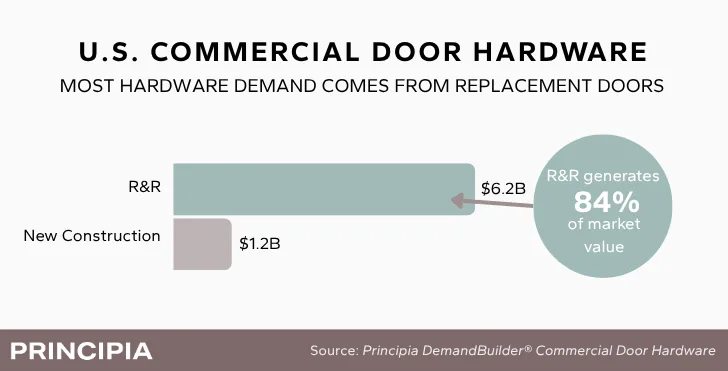
Existing Buildings Drive the Majority of Demand
The dominance of repair and replacement activity is not a temporary market condition. It is a structural feature of the industry.
The United States has more than five million commercial buildings, containing millions of door openings that require ongoing maintenance, code compliance updates, security enhancements, and technology upgrades. Every installed door represents future demand for locks, hinges, closers, exit devices, access control systems, and automatic operators. Across both new and existing buildings, commercial interior and exterior doors generate demand for nearly 50 million hardware components annually, with almost 40 million of that used in R&R applications. Because each opening requires ongoing maintenance, periodic replacement, and technology upgrades over time, every installed door becomes a recurring source of demand.
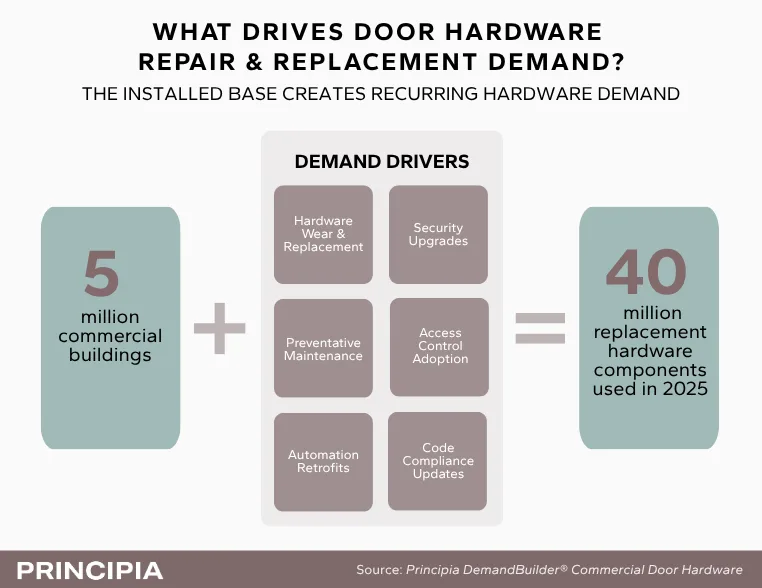
Unlike many building products that are largely purchased once during construction, commercial door hardware generates recurring demand throughout a building’s lifecycle.
What This Means for Manufacturers
Asphalt costs have remained highly volatile due to fluctuations in oil markets, while metal roofing products continue to face pressure from higher steel and aluminum costs. Multiple rounds of price increases have already moved through both asphalt and metal roofing systems this year, creating ongoing challenges for contractors, distributors, and manufacturers alike.
Construction starts tell only part of the story. While new construction remains an important source of specifications and future installed base growth, most annual demand comes from existing buildings.
The market is more resilient than many assume. Because demand is heavily tied to maintenance, modernization, and compliance requirements, hardware sales are generally less dependent on construction cycles than many other building product categories.
Installed-base visibility becomes a competitive advantage. Manufacturers that understand where products are in service, when replacement cycles occur, and how technology adoption is evolving are better positioned to identify growth opportunities and allocate resources effectively.
Looking for a better way to quantify that opportunity?
Principia’s Commercial Doors DemandBuilder® model provides manufacturers with a comprehensive view of demand across both new construction and replacement markets. By sizing the installed base, tracking replacement cycles, and identifying demand drivers across building segments, DemandBuilder® helps manufacturers uncover growth opportunities, prioritize investments, improve forecasting accuracy, and align go-to-market strategies with where demand is occurring.