A New Purchasing Dynamic is Emerging in Building Materials
Since 2024, Principia has tracked how lumberyards and traditional one-step distributors source building products. Over the past two years, an interesting shift has emerged: purchasing behaviors within the channel are evolving, and not all channel participants are moving in the same direction.
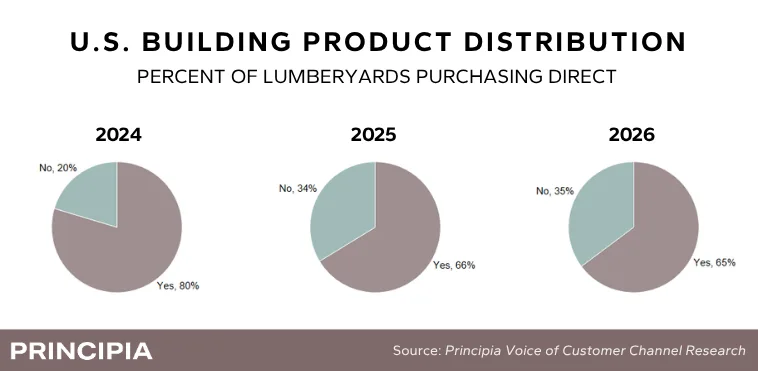
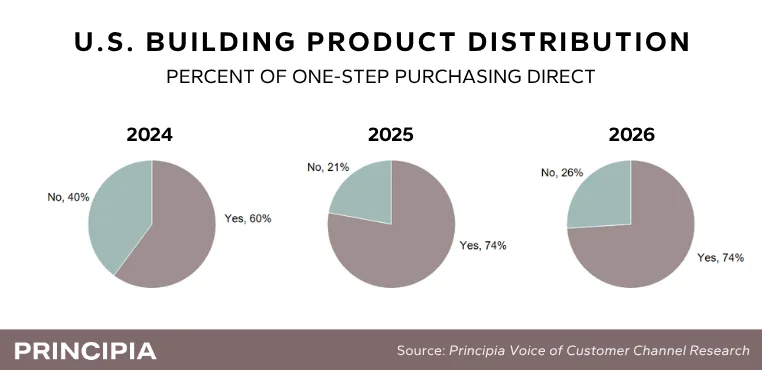
While direct purchasing remains the dominant model across the industry, our data suggests that lumberyards are purchasing directly from manufacturers less frequently than they were just two years ago. At the same time, traditional one-step distributors continue to demonstrate a strong preference for buying directly from manufacturers rather than sourcing through 2-step distributors.
These trends raise an important question: What is driving the change?

A Growing Operational Challenge for Lumberyards
The percent of lumberyards buying directly from manufacturers (versus buying from wholesale distributors) fell 15-points from 80% in 2024 to 65% in 2026.
The decline in direct purchasing among lumberyards may reflect growing operational pressures across the building products industry. One possible factor is the continued expansion of product assortments. Manufacturers across many categories have introduced new products, variations, specifications, and performance options in an effort to serve increasingly diverse customer needs. While these additions create opportunity, they also increase complexity throughout the supply chain.
For many lumberyards, purchasing directly from manufacturers often requires larger order quantities and greater inventory commitments. As product portfolios expand, carrying those inventories becomes more challenging. Dealers must allocate warehouse space across more categories, manage slower-moving products, and tie up additional working capital in inventory.
As a result, some lumberyards may be relying more heavily on distribution partners that can aggregate inventory and reduce the burden of stocking large quantities themselves. Importantly, SKU proliferation is a compelling explanation, but it is unlikely to be the only factor influencing purchasing behavior. Labor constraints, inventory costs, economic uncertainty, regional market dynamics, and evolving customer demand patterns may also be contributing to these changes.
Why One-Step Dealers Increasingly Buy Direct
The trend among traditional one-step dealers tells a different story. Our data shows that these organizations increasingly favor direct manufacturer relationships over sourcing through two-step distribution. The percent of one-steppers buying direct has risen from 60% in 2024 to 74% in 2026, a 14-point shift.
What This Means for Manufacturers
Whether driven by SKU proliferation, operational complexity, or a combination of market factors, these purchasing shifts deserve attention from manufacturers.
If lumberyards increasingly lean on two-step distribution partners to simplify inventory management, manufacturers may need to rethink channel strategies, inventory programs, minimum order requirements, and dealer support initiatives. At the same time, distributors could play an even more important role in helping manufacturers bring complex product portfolios to market.
Understanding not just what channel partners are buying, but how they are choosing to buy, may provide an early indicator of broader changes occurring throughout the building products supply chain.
The trends observed over the past two years suggest that the industry’s traditional purchasing model is evolving. For manufacturers, dealers, and distributors alike, the challenge now is understanding what is driving that evolution and what it means for the future of the channel.