What Roofing Capacity Changes Reveal About Supplier Strategy
By Lilli Tillman Smith, Roofing Industry Analyst
Roofing manufacturers continued investing in North American capacity throughout 2025 and into 2026, but the story extends beyond simply producing more roofing materials. Across steep-slope shingles, metal roofing, TPO membranes, and other roofing products, suppliers are repositioning manufacturing networks to improve service, support higher-value products, and prepare for future demand opportunities. While capacity has expanded, market performance remains driven more by demand conditions than production constraints.
Although residential new construction is expected to remain subdued, the growing frequency and severity of extreme weather events continue to reshape demand in the roofing industry. Manufacturers are responding by introducing more resilient roofing products while also building greater flexibility into their production networks, allowing capacity to be adjusted more quickly when market conditions change. As roofing shifts toward a home-hardening model, older and less efficient shingle plants are likely to face increasing pressure. Closures such as GAF’s Minneapolis plant in April 2026 may become more common as manufacturers seek to align capacity with demand and avoid oversupply that could erode pricing.
Capacity Expansion Reflects Long-Term Confidence
Over the past 18 months, roughly 20 notable roofing capacity changes have been announced across North America. Expansions, line upgrades, conversions, and facility investments have significantly outnumbered closures across both residential and commercial roofing categories.
Rather than focusing solely on output, manufacturers are prioritizing strategic positioning. Investments are improving regional coverage, reducing transportation costs, increasing manufacturing efficiency, and aligning production with changing customer preferences. As a result, the industry navigates 2026 with greater manufacturing flexibility and a broader geographic footprint.
Steep-Slope Roofing Capacity Remains a Priority
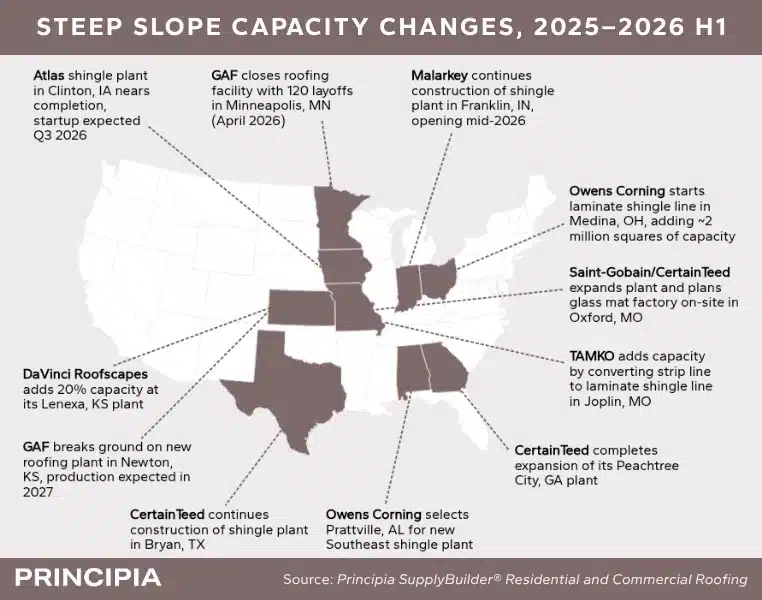
Much of the recent roofing capacity activity has centered on steep-slope products, particularly asphalt shingles. Recent announcements include new plant construction, facility expansions, and production-line upgrades designed to increase capacity and improve manufacturing efficiency.
Several investments also highlight the industry’s ongoing shift toward laminated shingles, including line conversions away from lower-value 3-tab products. These investments reflect continued confidence in residential reroofing demand, where homeowners increasingly favor products offering enhanced durability, aesthetics, and long-term performance.
Geographically, many of these projects are concentrated in Texas and the central United States, reinforcing the importance of these regions as manufacturing and distribution hubs. At the same time, suppliers continue to optimize production networks to improve service levels and support future replacement demand.
Other Roofing Segments Show Strategic Investment
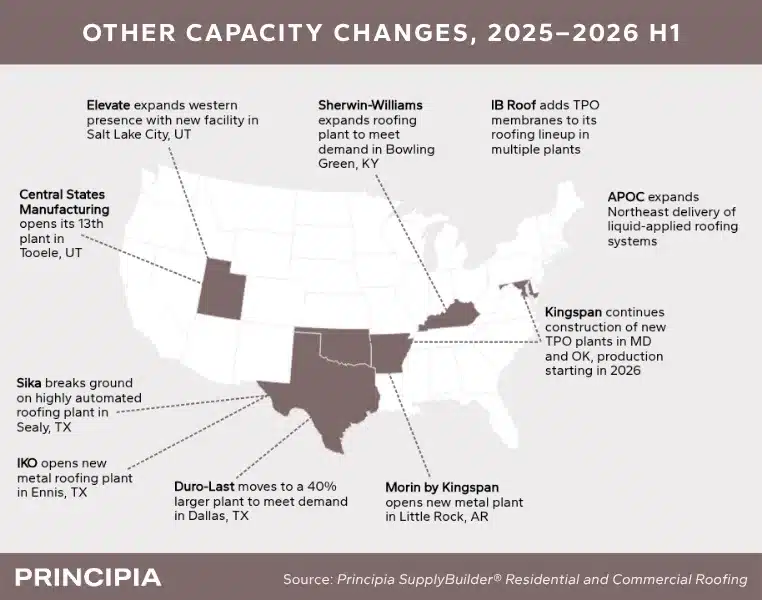
Beyond shingles, manufacturers continue investing in higher-growth roofing categories, including metal roofing, TPO membranes, liquid-applied roofing systems, and other advanced roofing products.
Many of these projects are focused less on adding broad-based capacity and more on expanding participation in premium segments that have outperformed the broader roofing market. Investments in TPO manufacturing, metal roofing production, and highly automated facilities reflect growing customer demand for energy efficiency, durability, resilience, and lifecycle value.
The geographic distribution of these projects also underscores a growing emphasis on network optimization. New facilities and expansions in markets such as Texas, Utah, Kentucky, Arkansas, and Oklahoma help suppliers improve regional coverage, shorten delivery distances, and strengthen competitive positioning in key growth areas.
What This Means for the Roofing Market
The geographic distribution and product mix of recent capacity investments suggest roofing manufacturers remain confident in long-term demand, particularly for laminated shingles, metal roofing, and TPO systems. The industry is not currently facing widespread supply constraints; instead, future performance will depend on demand drivers such as residential reroofing activity, commercial replacement spending, premium product adoption, and broader construction trends.
If demand grows as expected, these investments will help suppliers improve service levels, support regional growth, and capture share in higher-value product categories. However, if market growth falls short of expectations, increased competition and excess capacity could place pressure on pricing and utilization rates. In either environment, manufacturers with efficient operations, strong regional networks, and differentiated product offerings will be best positioned to succeed.
Capacity investments reveal where manufacturers see future opportunity, but understanding the competitive implications requires deeper market visibility. Principia’s SupplyBuilder® Roofing provides detailed insights into supplier market share, distribution channels, and regional market dynamics, helping building product manufacturers identify growth opportunities and benchmark their market position.