Which Buildings Are Driving Door Hardware Growth?
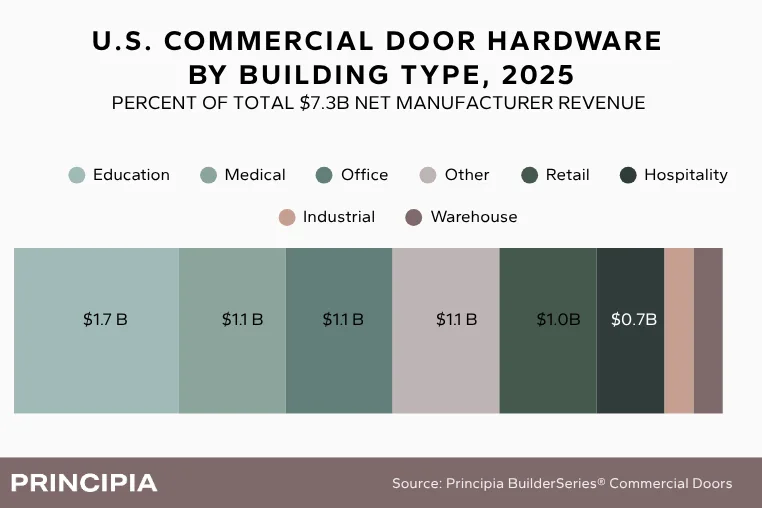
The U.S. commercial door hardware market exceeds $7 billion annually, but growth isn’t occurring evenly across building types. Demand is increasingly concentrated in facilities that require greater security, automation, accessibility, and operational control—and that shift is reshaping both where value exists today and where growth will occur through 2028.
Value Has Already Moved Up the Stack
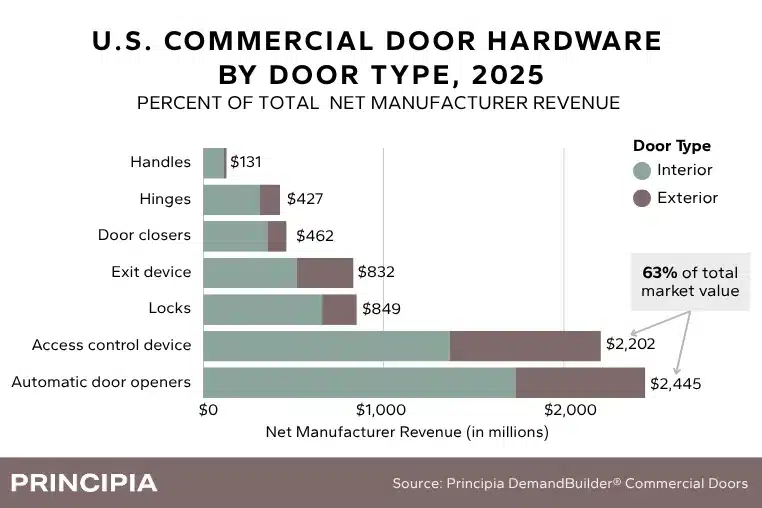
The market is no longer defined by traditional mechanical hardware alone.
Access control devices and automatic door operators now account for roughly two-thirds of total market value, reflecting a structural shift toward electronic security, automation, and intelligent building systems.
Today’s Revenue Leaders: Education, Office, and Healthcare
Three segments anchor current demand, but each for different strategic reasons:
- Education remains the largest market. Hardware demand is supported by ongoing renovation cycles, school safety initiatives, campus access management, and ADA-driven upgrades. Unlike many mature segments, education combines scale with continued modernization.
- Office remains a major source of value. Buildings often have a high concentration of electronic and integrated hardware. Growth is moderate, but specification levels remain among the highest in the market.
- Healthcare combines high spending intensity with above-average growth. Hospitals and medical facilities rely heavily on controlled access, touchless operation, life-safety hardware, and compliance-driven solutions, creating some of the highest hardware content per opening.
The Fastest-Growing Opportunity: Warehouses
Warehouses represent a smaller share of today’s demand(~$300 million), but they are emerging as a key growth driver.
Modern logistics facilities – particularly e-commerce fulfillment and distribution centers- are rapidly increasing their use of access control, traffic management and automation systems. As a result, warehouses are posting some of the fastest forecast growth rates across access control, automatic operators, locks, and exit devices.
While specification levels remain below healthcare and many office environments, the gap is narrowing.
Other Key Segments: Retail, Public, and Industrial
- Retail continues to generate steady demand, especially where high traffic volumes drive the need for durability, accessibility and automated entry.
- Public facilities (government, transportation, convention centers) are steadily increasing adoption of integrated security and access control, support higher-value hardware demand.T
- Industrial facilities are evolving as well. Advanced manufacturing, pharmaceutical, food processing, and other regulated environments increasingly require controlled access and enhanced security, gradually shifting hardware demand toward more sophisticated solutions.
The Pattern That Matters
Across all major building types, a consistent pattern is emerging:
The highest-value and fastest-growing opportunities are concentrated in buildings with the greatest operational complexity.
Security requirements, access control, compliance, and automation, not just building volume are not the primary drivers of hardware demand.
Bottom Line
The commercial door hardware market is undergoing a fundamental shift from mechanical products to connected, controlled, and automated openings.
Healthcare, education, and office buildings generate the greatest value today. Warehouses are driving some of the strongest growth. Across all segments, the highest-value hardware follows building complexity.