Nailing Down the Trends: Roofing Midyear 2026
The roofing market remains active, but not all activity is equal.
One of the defining characteristics of 2026 has been the widening gap in performance across roofing segments, with demand varying significantly by market, building type, and location.
Commercial and low-slope roofing continue to outperform residential steep-slope, while reroofing remains the primary source of demand stability. The key challenge is that volume alone is no longer a reliable indicator of market health. Margins, purchasing behavior, and channel dynamics are becoming just as important as top-line activity.
Four Trends to Watch Through Year-End
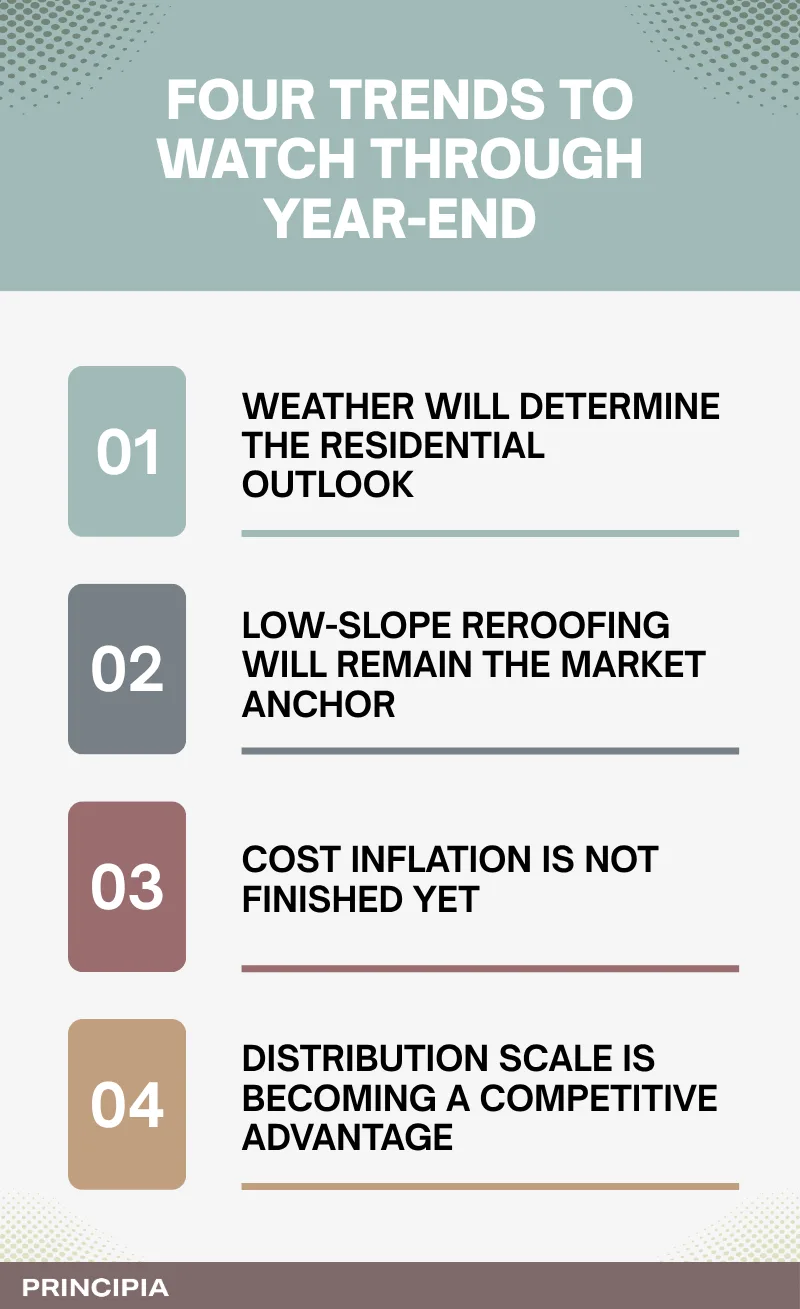
1. Weather Will Determine the Residential Outlook
Residential steep-slope remains the market’s weakest segment. While interest rates, insurance dynamics, and housing turnover continue to weigh on demand, weather remains the biggest swing factor for the second half of 2026.
A more active storm season could quickly improve reroof activity and shingle demand. A quieter season would likely leave contractors operating cautiously and keep residential volumes below historical expectations. For manufacturers, weather-related demand remains the key variable to watch through year-end.
2. Low-Slope Reroofing Will Remain the Market Anchor
Commercial reroofing continues to provide the industry’s strongest demand foundation. While some projects have been delayed amid economic uncertainty and higher costs, roof replacement can only be deferred for so long before performance and risk become concerns. Labor constraints add another layer of urgency, as building owners that postpone work may find themselves back at the end of increasingly long contractor waitlists. As a result, commercial reroofing demand should remain relatively resilient even if project timing shifts.
3. Cost Inflation Is Not Finished Yet
Pricing remains one of the industry’s biggest challenges heading into the second half of 2026.
Asphalt costs have remained highly volatile due to fluctuations in oil markets, while metal roofing products continue to face pressure from higher steel and aluminum costs. Multiple rounds of price increases have already moved through both asphalt and metal roofing systems this year, creating ongoing challenges for contractors, distributors, and manufacturers alike.
Unless geopolitical conditions improve meaningfully, particularly ongoing conflicts that continue to impact energy and commodity markets, additional pricing pressure is likely. The risk is no longer a supply shock, but a steady stream of cost increases that complicate bidding, compress margins, and make project timing more uncertain.
4. Distribution Scale Is Becoming a Competitive Advantage
Consolidation continues to reshape the roofing channel.
Larger distributors are gaining greater influence over inventory positioning, pricing execution, contractor relationships, and local market access. As these networks become more integrated, manufacturers will need to think beyond product differentiation and focus more heavily on channel strategy.
Control of the contractor relationship is increasingly becoming a strategic advantage across the value chain.
What Matters Most for Manufacturers
The second half of 2026 is unlikely to be defined by a broad market recovery. Instead, success will depend on navigating a market that remains split between resilient commercial demand and cautious residential activity.
Key considerations for manufacturers:
The roofing market is still moving forward, but the winners in the second half will be the companies focused less on aggregate demand and more on where profitability, purchasing confidence, and channel control are actually developing.
- Stay aligned with commercial reroof opportunities
- Monitor residential ordering patterns closely
- Prepare for ongoing raw material and cost volatility
- Strengthen channel relationships as distribution influence grows
- The roofing market is still moving forward, but the winners in the second half will be the companies focused less on aggregate demand and more on where profitability, purchasing confidence, and channel control are actually developing.
The roofing market is still moving forward, but the winners in the second half will be the companies focused less on aggregate demand and more on where profitability, purchasing confidence, and channel control are actually developing.