Five Regulatory Forces Shaping U.S. Commercial HVAC
By: Casey Olson, Senior Industry Analyst, and Angela Wang, Associate Industry Analyst
In commercial HVAC, regulation doesn’t just set the rules. It sets the replacement cycle, the spec, and often the budget.
When people talk about the U.S. commercial HVAC market, they usually focus on construction cycles, weather patterns, or emerging technologies. But one of the strongest market drivers rarely makes headlines: regulation.
Codes, standards, and incentives steadily reshape what gets installed, when older equipment becomes obsolete, and how much building owners are willing, or required, to invest. In many projects, regulation isn’t a constraint. It’s the business case.
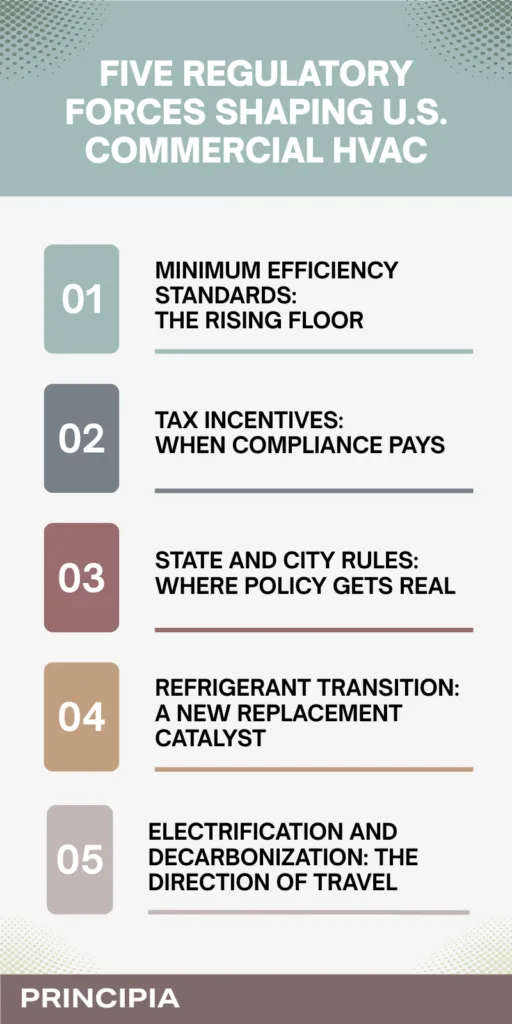
Below are five regulatory forces shaping commercial HVAC equipment demand, replacement activity, and product strategy today:
1. Minimum Efficiency Standards: The Rising Floor
Federal equipment efficiency standards continually increase the baseline performance required for commercial HVAC equipment. Each update effectively lifts the “floor” for efficiency.
What this means in practice:
- Older equipment becomes economically and sometimes legally obsolete
- Replacement planning often accelerates ahead of new compliance dates
- Average equipment selling prices trend upward as higher performance becomes the baseline
- Manufacturers compete on advanced features, not just capacity and reliability
These regulatory steps are durable and difficult to reverse. Once a new minimum is in place, the market moves with it, often creating replacement demand even when construction slows.
2. Tax Incentives: When Compliance Pays
The current federal tax framework has made energy efficiency financially attractive, not just environmentally responsible. The 179D commercial buildings deduction, for example, rewards owners for meaningful energy reductions in lighting, envelope, and HVAC. In many projects, HVAC upgrades carry the largest share of achievable savings.
What this means:
- Incentives improve project economics, making large HVAC retrofits easier to justify
- High-efficiency systems compete more effectively against like-for-like replacements
- System specifications increasingly reflect incentive requirements, shifting demand toward higher-efficiency equipment
These incentives don’t force action, but they often influence when projects move forward and what equipment ultimately gets specified.
3. State and City Rules: Where Policy Gets Real
The most aggressive regulatory pressure is often local, not federal. Large cities and states are rolling out building performance standards that require reductions in energy use or carbon emissions over time. Owners of underperforming buildings may face penalties or mandatory improvements.
HVAC is frequently the largest energy lever available to help meet these requirements.
What this means:
- HVAC upgrades often become one of the most practical paths to compliance
- Controls, heat pumps, and system optimization gain share as owners seek cost-effective ways to improve building performance
- Portfolio owners increasingly plan multi-year upgrade programs to avoid future compliance costs
Local policy is increasingly influencing when upgrades occur and which technologies gain adoption.
4. Refrigerant Transition: A New Replacement Catalyst
The phasedown of high-GWP refrigerants is reshaping equipment decisions across commercial HVAC. As owners evaluate aging systems, refrigerant strategy is becoming an increasingly important consideration alongside energy performance and reliability.
What this means:
- Equipment platforms continue evolving around lower-GWP refrigerants
- Older systems become less attractive to maintain over time
- Replacement decisions increasingly reflect both refrigerant and efficiency considerations
Refrigerant policy is creating another layer of replacement demand while influencing future product design.
5. Electrification and Decarbonization: The Direction of Travel
Even without mandates, the trend toward lower carbon, higher efficiency, and reduced onsite combustion is clear. Federal, state, and local policies continue encouraging cleaner energy use.
What this means:
- Heat pumps and hybrid systems are positioned well to gain share in many commercial segments
- Manufacturers increasingly align product roadmaps with lower-carbon system designs
- Electrification becomes a structural, long-term shift
Bottom line: Electrification remains a gradual shift, but it is already influencing product development, system specifications, and long-term equipment demand.
The Big Picture
Regulation in U.S. commercial HVAC rarely arrives as a single dramatic change. Instead, it shows up as:
- Incrementally tighter federal standards
- Financial incentives that reward efficiency
- Local rules that push performance and penalize underinvestment
- Refrigerant policies that influence equipment design and replacement decisions
Individually, these forces may look modest. Together, they create a steady current pushing the market toward higher-value, higher-efficiency, and lower-emissions systems.
Regulation doesn’t constrain the HVAC market. It grows it, upgrades it, and makes it more sophisticated. For equipment manufacturers, understanding these forces is increasingly important for forecasting demand, planning product strategy, and anticipating where growth will emerge next.
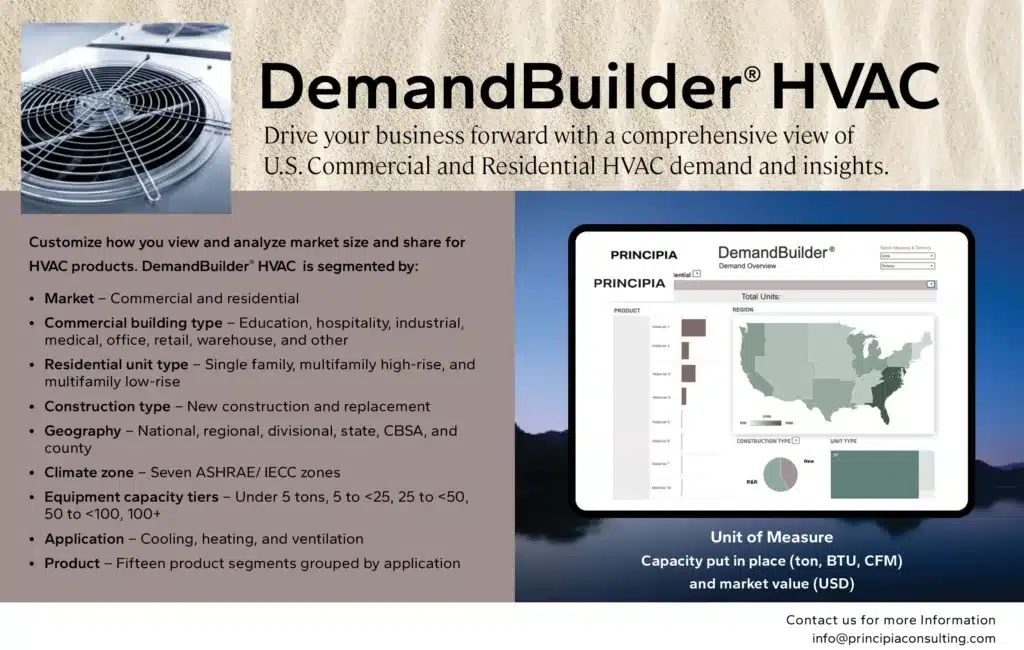
DemandBuilder® HVAC helps manufacturers quantify these market shifts with five-year forecasts across commercial and residential markets, segmented by product, geography, building type, construction activity, and more. Whether evaluating replacement demand, technology adoption, or regional growth opportunities, manufacturers gain an independent view of the market to support forecasting and demand planning.