What Pricing Trends in 2025 Reveal About the Decking Market in 2026
By Richard Wildanger, Decking and Railing Industry Analyst
As decking manufacturers evaluate market conditions in 2026, one of the most important lessons from last year is that revenue growth did not always reflect positive demand. While reported sales remained relatively stable across portions of the market in 2025, pricing and product mix shifts often masked softer project activity and volume trends.
Revenue and Demand Didn’t Tell the Same Story
Revenue growth is often viewed as a sign of market strength. In 2025, however, inflationary pressures, labor costs, transportation expenses, energy costs, and tariffs affected decking materials differently. Some manufacturers benefited from price increases that helped offset softer shipment volumes, some were able to implement price increases amidst positive product demand, while others faced competitive pressures that limited their ability to raise prices.
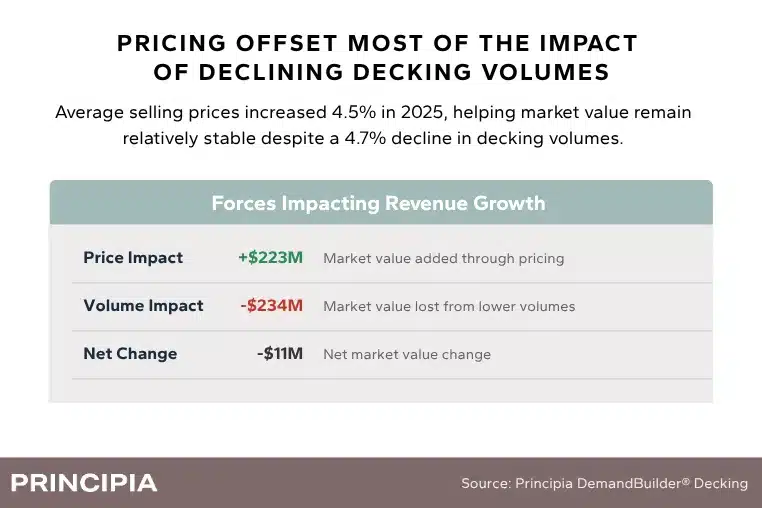
Across the decking market, higher prices added roughly $223 million in market value during 2025. However, declining volumes reduced market value by approximately $234 million, illustrating why revenue trends alone did not fully reflect underlying demand conditions.
This created varying experiences across the supply chain. A manufacturer may have reported stable revenue while dealers experienced slower project activity, increased price shopping, material trade downs, or smaller average orders. Likewise, distributors, dealers, and contractors often felt weakening demand sooner than topline market value figures suggested. The result was a market where revenue performance and underlying demand were not always aligned. The graphic below illustrates how pricing largely offset declining volumes, creating a much different revenue picture than volume trends alone would suggest.
Material Pricing Reshaped Buyer Decisions
Pricing dynamics also influenced competition between decking materials. Rising prices for cedar, redwood, and hardwood decking improved the relative value proposition of wood-alternative products. As the cost gap narrowed, some homeowners found it easier to justify low-maintenance composite and PVC decking based on durability and long-term ownership costs.
Pressure-treated lumber remained the exception. With relatively stable pricing, it continued to offer an attractive option for budget-conscious buyers and helped preserve demand. These shifting price relationships illustrate why material-specific demand trends often reveal more about market conditions than revenue figures alone.
The market also highlighted growing differences in buyer behavior. Entry-level buyers remained highly sensitive to upfront project costs, making even modest price increases meaningful. Higher-end buyers generally maintained a willingness to invest in outdoor living projects, but many scrutinized value more closely than in previous years and often traded down to lower cost versions. Performance, aesthetics, durability, and maintenance requirements all played a larger role in purchase decisions.
What This Means for the Market
Many manufacturers entered 2026 asking whether revenue gains achieved through pricing can be sustained if consumers remain budget-conscious amidst low consumer confidence and uneven project activity.
That question underscores the key takeaway from 2025: revenue growth should not be viewed in isolation. Pricing, product mix, and consumer confidence all influence reported market performance. As manufacturers evaluate opportunities in 2026, separating price-driven growth from volume growth is only part of the equation. Changes in product mix and competitive market share can be just as important for understanding where demand is strengthening, where substitution is occurring, and which suppliers are capturing growth opportunities.
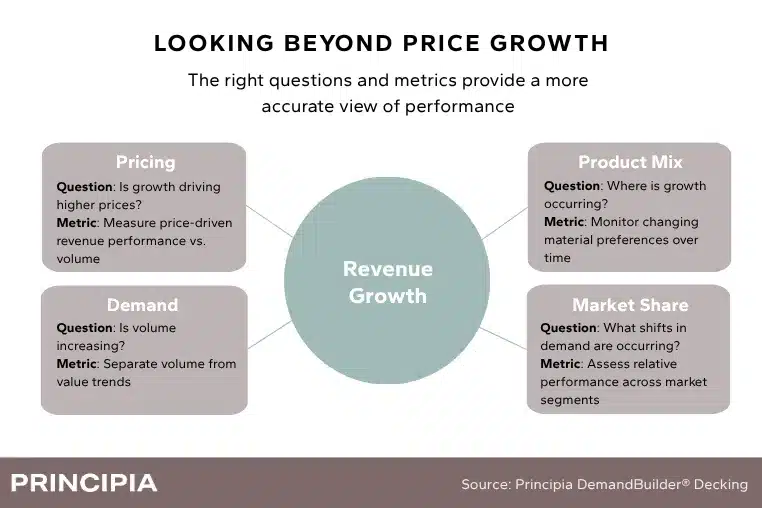
Principia’s DemandBuilder® Decking helps decking manufacturers separate the effects of pricing, demand, and market share, providing a more accurate picture of market performance. By tracking demand trends, pricing dynamics, product mix shifts, and competitive share movement, manufacturers can better understand whether growth is being driven by stronger underlying demand or by pricing and product mix effects. That visibility helps organizations make more informed decisions about forecasting, production planning, investment, and go-to-market strategy.