Reading Between the Walls: Insulation Midyear 2026
By: Lilli Tillman Smith, Insulation Industry Analyst
The insulation market entered the second half of 2026 with residential demand still searching for momentum while commercial markets provided better support for growth. Remodeling activity remained a brighter spot, helping offset softer single-family construction, while investments in data centers, electrification, and energy efficiency supported nonresidential demand. At the same time, manufacturers continued adding production capacity through new lines, plant expansions, debottlenecking projects, and facility upgrades across insulation and broader building-envelope products despite an uneven demand environment. This creates the potential for greater competitive pressure if volumes do not improve. Supply chain disruptions and tighter MDI availability added cost uncertainty, while ongoing channel consolidation increased the importance of scale, relationships, and specification influence.
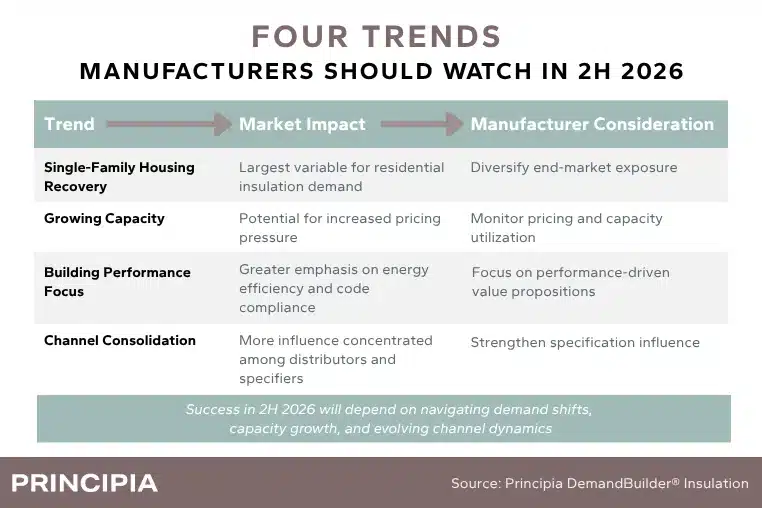
Key Variables To Keep An Eye On
Single-Family Housing Remains the Key Variable
A sustained recovery in single-family construction would meaningfully improve demand for fiberglass, spray foam, and related residential insulation categories. Without it, growth is likely to remain concentrated in remodeling and retrofit activity.
While Dodge expects multifamily starts growth to offset a low-single-digit decline in single-family starts in 2026, the mix shift is less favorable for insulation demand, as multifamily construction typically uses about 30% less insulation than single-family housing. There is potential upside if mortgage rates fall meaningfully or housing-focused legislation such as the Road to Housing Act stimulates additional single-family activity, but these factors remain speculative and are not central to the current forecast.
Supply Growth Could Outpace Demand
Commercial reroofing continues to provide the industry’s strongest demand foundation. While some projects have been delayed amid economic uncertainty and higher costs, roof replacement can only be deferred for so long before performance and risk become concerns. Labor constraints add another layer of urgency, as building owners that postpone work may find themselves back at the end of increasingly long contractor waitlists. As a result, commercial reroofing demand should remain relatively resilient even if project timing shifts.
Building Performance Is Becoming the Sales Story
For products such as polyiso, specification decisions are increasingly tied to broader building-performance outcomes rather than standalone product attributes. Environmental transparency, energy efficiency, code compliance, and whole-system performance are becoming more important differentiators.
As of June 2026, 14 states have adopted residential energy codes at or above IECC 2021, while 22 states plus Washington, D.C., have adopted ASHRAE 90.1-2019 or higher. As building performance becomes the primary value proposition, stricter codes are increasing insulation requirements in new construction while also supporting retrofit activity as older buildings are upgraded to improve energy efficiency.
Channel Influence Is Growing
Consolidation is not just making distributors larger. It is concentrating influence over specifications, contractor relationships, and project execution. Companies that strengthen their position with key channel partners may gain an advantage that extends well beyond pricing or product features.
What This Means for Manufacturers
The market remains workable, but less forgiving. New supply, uneven residential demand, and shifting channel dynamics will reward companies that can differentiate beyond product alone. Commercial exposure, specification influence, and building-performance positioning may prove just as important as volume growth in the months ahead.
Manufacturers should closely evaluate their exposure across residential, commercial, and retrofit end markets as demand conditions continue to diverge. Companies heavily dependent on new residential construction may face continued volatility, while those with stronger positions in commercial, institutional, or renovation-driven segments could benefit from more stable demand. At the same time, growing capacity and channel consolidation increase the importance of strategic pricing, specification influence, and customer relationships.
As insulation manufacturers navigate an uneven demand environment, understanding where growth opportunities are emerging will be critical. DemandBuilder’s market forecasts and industry intelligence help manufacturers track market shifts, evaluate risk, and make more informed strategic decisions.