Four Ways Suppliers Are Unlocking Capacity Without Expanding Operations
By Richard Wildanger, Decking, Railing and Fencing Industry Analyst
After four years of demand volume declines, the U.S. residential railing market is expected to return to slightly positive volume growth in 2026. Throughout the downturn and into the early stages of recovery, many railing suppliers focused more on optimizing existing operations rather than pursuing major production capacity expansion. That approach reflected a market characterized by uneven demand, soft repair and remodeling activity, and ongoing cost uncertainty. However, limited capacity expansion did not mean suppliers stood still. Many pursued growth through operational improvements, portfolio expansion, acquisitions, and channel development.
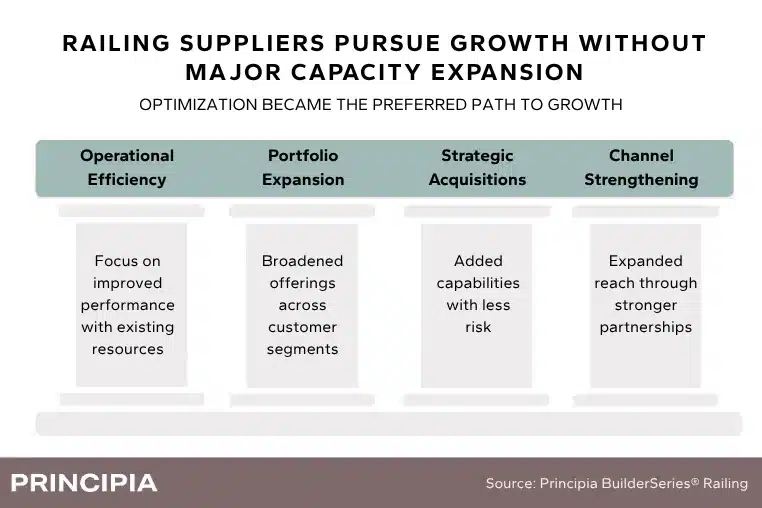
Focus on improved performance with existing resources. This can include streamlining product lines, prioritizing faster-moving SKUs, improving fill rates, managing inventory more tightly, and aligning production with channels that offered better visibility into demand. In a cautious market, operational discipline can matter as much as physical expansion.
Broadened offerings across customer segments. Railing buyers increasingly compare materials based on maintenance, appearance, installation ease, and total project cost. Suppliers with broad enough portfolios can serve different price points and applications without necessarily building new facilities. In some cases, the better growth lever may be product breadth, attachment to related outdoor living purchases, or stronger channel execution. Some suppliers added entirely new railing materials to their portfolios.
Added capabilities with less risk. Some suppliers expanded their railing portfolios by acquiring other railing suppliers rather than building entirely new capabilities from the ground up. That approach can add materials, designs, fabrication know-how, or regional reach while limiting the risk of committing to large greenfield projects in a softer demand environment.
Expanded reach through stronger partnerships. Railing is SKU-intensive, and availability can influence contractor preference. Suppliers that emphasize the importance of distributor relationships, dealer support, displays, or product training strengthen market position without committing to large capacity projects.
The broader takeaway is that limited capacity expansion does not necessarily mean suppliers are idle. In a market where revenue growth can be driven more by price than volume, market participants are leaning towards a focus on efficiency, mix, service, and channel reach. If demand strengthens, those investments may prove just as important as added production capacity.
Understanding whether growth is being driven by new construction, repair and remodeling activity, or shifts in material preferences is critical for railing suppliers evaluating future investments. Principia’s BuilderSeries® tracks demand trends across residential building product categories, helping manufacturers identify emerging opportunities, monitor market conditions, and make more informed capacity, product, and channel decisions.