How Commercial Builders Are Meeting Insulation Requirements: Insights from 150 Builders and Contractors
By Lilli Tillman Smith, Insulation Industry Analyst
In today’s landscape of rising energy efficiency standards and climate-conscious construction, how commercial builders choose to comply with insulation requirements says a lot about industry priorities and challenges. A recent Principia survey of 150 commercial builders and contractors examined the code compliance pathways they most commonly use to meet insulation requirements, including prescriptive, performance-based, and trade-off approaches. The findings reflect broader industry trends toward performance-based compliance, highlighting builders’ increasing focus on design flexibility, whole-building energy performance, and cost optimization.
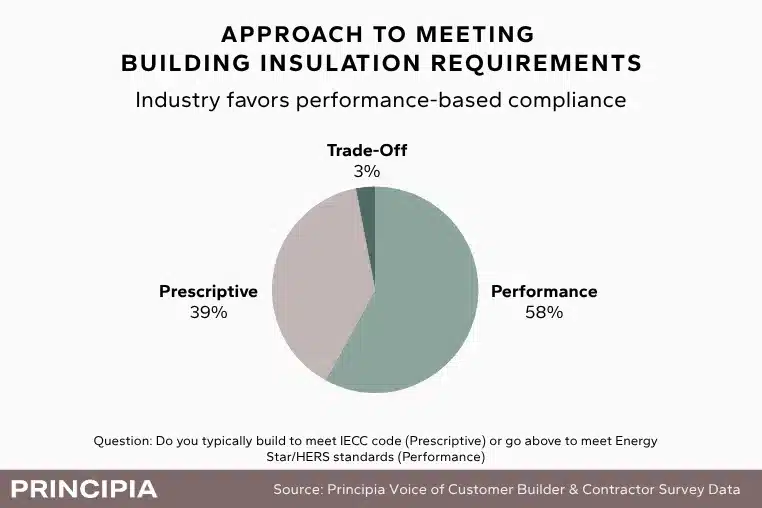
Survey Results: A Clear Preference for Performance
The chart above illustrates how respondents reported approaching insulation requirements in their recent commercial projects. The data highlights a clear preference toward performance-based compliance, with a majority of builders opting for this more flexible and often innovation-friendly strategy. Let’s break down what this means and why it matters.
What Are the Options for Code Compliance?
Commercial building energy codes in the U.S., primarily based on ASHRAE 90.1 and the International Energy Conservation Code (IECC), allow multiple compliance pathways for meeting insulation and other envelope performance requirements:
- Prescriptive Approach: This is the most straightforward path, requiring builders to follow set minimum standards for each building component (e.g., R-values for walls and roofs). It’s a “check-the-box” method that simplifies documentation but limits design flexibility.
- Performance-Based Approach: This method assesses overall energy performance using software modeling. Builders can trade off higher efficiency in some components (like HVAC or lighting) for slightly lower performance in others (like insulation), as long as the building meets total energy-use targets.
- Trade-off Method: This is a hybrid between prescriptive and performance paths and allows limited substitutions within a component category. It’s the least commonly used path—reflected in only 3% of survey respondents selecting it.
Why Performance-Based is Winning
Builders and contractors prefer the performance path which speaks to evolving industry priorities:
- Greater Design Flexibility: Builders and architects are increasingly designing high-performance buildings with integrated systems. A performance approach accommodates this innovation by measuring whole-building energy use instead of enforcing rigid material-by-material standards.
- Cost Optimization: Modeling software can identify where insulation levels can be reduced without compromising energy goals—potentially cutting construction costs or reallocating budget to more effective upgrades elsewhere.
- Alignment with Incentives and Green Building Certifications: Many utility programs and certification systems like LEED reward performance metrics over prescriptive compliance, nudging builders toward this strategy.
Why Prescriptive Still Holds Ground
While performance-based strategies lead, nearly 4 in10 builders still choose the prescriptive route. This often comes down to:
- Simplicity and Speed: Especially for small to mid-sized projects, the prescriptive path reduces administrative burden and speeds up approval timelines.
- Code Familiarity: Many jurisdictions have adopted recent versions of ASHRAE 90.1 or the IECC, but not all plan reviewers are comfortable interpreting performance models. In such areas, prescriptive compliance may be safer or preferred.
Implications for the Future
As energy codes continue to evolve, especially with ASHRAE 90.1-2022 now including requirements for onsite renewable energy and more advanced envelope performance metrics, we can expect even greater reliance on performance modeling. Tools that help builders model energy use and manage compliance (like COMcheck and EnergyPlus) are becoming critical components of the builder’s toolkit.
Final Thoughts
This survey shows that commercial builders are clearly prioritizing flexibility and performance in their insulation strategies. The move away from a one-size-fits-all approach reflects a maturing industry; one that recognizes the nuanced trade-offs between materials, systems, and costs.
As codes become more complex and performance expectations rise, it will be increasingly important for designers, contractors, and code officials to work collaboratively and leverage digital tools to meet energy goals efficiently and effectively.
Sources:
• U.S. Department of Energy – Building Energy Codes
• ASHRAE Standard 90.1-2022 Highlights
• IECC Commercial Code Overview