Residential Railing: Why Consolidation Hasn’t Eliminated Market Fragmentation
By Richard Wildanger, Decking, Railing, Fencing, and Flooring Industry Analyst
Residential railing remains a fragmented market. It spans wood, metal, composite, vinyl, and mixed-material systems, each with different manufacturing requirements, installation practices, buyer preferences, and routes to market. These differences create opportunities for a wide range of suppliers and make it difficult for any single business model to dominate the category.
Regional Service Matters
Fragmentation is especially persistent where regional supply and job-specific support matter. Local and regional suppliers can compete effectively when contractors value quick turnaround, customization, code familiarity, and reliable jobsite service. In many markets, scale provides advantages, but it does not eliminate the importance of local relationships and responsiveness.
Material Diversity Keeps Suppliers Specialized
The wide range of railing materials continues to support a diverse supplier base. Wood railing remains connected to established lumber and treated-wood distribution networks, while metal, vinyl, and composite systems often include standardized, custom, or semi-custom solutions. This allows smaller manufacturers and fabricators to maintain meaningful positions in regional markets despite competition from larger brands.
Regional Remodeling Demand Reinforces Fragmentation
Demand drivers vary considerably across regions, creating localized opportunities for suppliers. Residential railing demand is often influenced by deck replacement activity, remodeling trends, weather exposure, building practices, and homeowner preferences. Because these factors differ by market, suppliers with strong regional knowledge and contractor relationships can maintain competitive advantages that are difficult to replicate nationally. This helps explain why market share gains often occur regionally before expanding to a broader footprint.
Consolidation Is Happening
While the market remains fragmented, consolidation continues to gradually reshape the competitive landscape. Larger manufacturers benefit from broader product portfolios, stronger brand recognition, and established distribution networks. Many are also expanding their presence in outdoor living by offering integrated solutions that combine decking, railing, lighting, and accessories. These strategies can strengthen customer relationships and improve visibility across multiple product categories.
Why Fragmentation Is Likely to Persist
Despite ongoing consolidation efforts, fragmentation is unlikely to disappear anytime soon. The category’s material diversity, regional demand differences, customization requirements, and service expectations continue to create room for a wide range of competitors. Markets that require local expertise, contractor support, and project-specific solutions remain difficult to consolidate quickly, allowing regional and specialty suppliers to maintain important roles in the market.
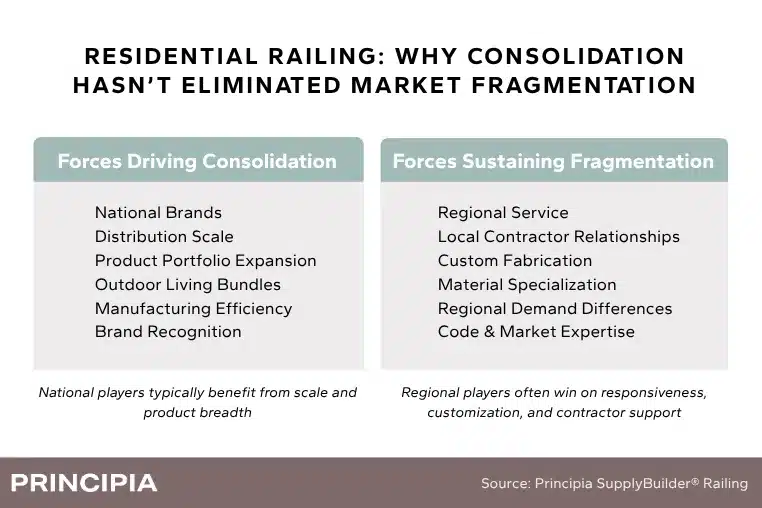
The residential railing market continues to balance two opposing forces: increasing consolidation and durable regional competition. National suppliers are pursuing growth through scale, distribution reach, product breadth, and outdoor living portfolios, while regional competitors continue to benefit from responsiveness, customization capabilities, and local market expertise.
What This Means for the Market
Fragmentation should not be viewed as a sign of market immaturity. Instead, it reflects the way residential railing products are bought, specified, stocked, and installed. While national suppliers continue to pursue growth through scale, distribution reach, and broader outdoor living portfolios, regional competitors maintain advantages through responsiveness, customization, and local market expertise. As a result, the companies best positioned for future growth will likely be those that understand how consolidation and fragmentation are evolving across specific geographies, channels, and material segments.
For companies looking to identify where competitive share is shifting and where regional opportunities remain strongest, Principia’s BuilderSeries provides market sizing, share estimates, channel intelligence, and demand forecasts to support more informed strategic planning and investment decisions.