Why Distribution Is Becoming a Bigger Driver of Building Product Market Share
By Casey Olson, Senior Industry Analyst
Building product manufacturers have always depended on distribution to connect their products with dealers, contractors, and ultimately end customers. But as the two-step distribution channel consolidates, those relationships are becoming increasingly important to competitive growth.
Recent moves in decking and siding illustrate the shift. Trex named Specialty Building Products (SBP) its sole national distributor for decking and railing while expanding relationships with select regional distributors. James Hardie expanded its relationship with Boise Cascade, making it the sole nationwide distributor of the combined Hardie, TimberTech, and AZEK exterior products portfolio. Most recently, LP Building Solutions announced a new SmartSide distribution strategy built around SBP nationally and a select group of regional partners.
While the individual strategies differ, the broader direction is similar: manufacturers are reassessing how their products reach the market and aligning more closely with distributors they believe will help drive growth.
Scale Is Changing the Two-Step Channel
Consolidation has created larger distribution platforms with broader geographic coverage, extensive dealer relationships, and increasingly sophisticated logistics and sales capabilities. That scale gives manufacturers an opportunity to reach more customers through fewer channel relationships.
But reach is only part of the equation.
The value of a distribution partner increasingly includes its ability to maintain local inventory, support a broad product portfolio, educate dealers and contractors, coordinate sales and marketing efforts, and actively develop a manufacturer’s brand.
That represents an important shift from simply getting a product into the channel to maximizing its position within the channel.
Distribution Can Influence Market Share
The impact can be particularly significant in categories such as siding, decking, railing, and specialty exterior products, where the two-step channel plays an important role in connecting manufacturers with a fragmented network of dealers and contractors.
Availability matters. A product that is locally stocked, supported by the distributor sales team, and readily available to dealers can have an advantage over a competing product that requires additional lead time or special ordering.
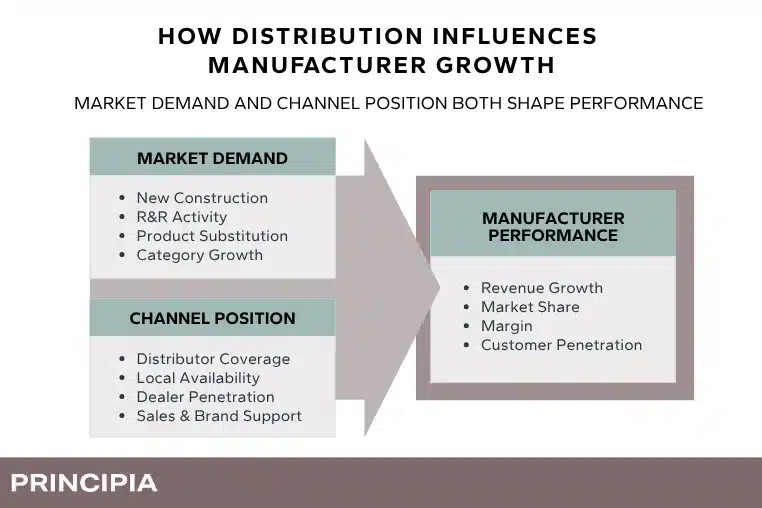
As a result, changes in distribution can influence manufacturer performance even when underlying market demand remains relatively unchanged. This is especially important in today’s demand environment of slow single family home construction and homeowners hesitant to undertake home improvement projects.
A manufacturer expanding into new distributor territories may gain dealer access and market share without any corresponding increase in construction or remodeling activity. Conversely, losing a key distribution relationship can create headwinds even in markets where end-use demand remains stable.
What This Means for the Market
For building product manufacturers, understanding growth increasingly requires looking beyond the direction of the overall market. Distribution footprint, dealer access, product availability, and channel commitment can all influence which companies outperform or underperform underlying demand.
The recent realignments among major building product manufacturers suggest those factors may become even more important as the distribution landscape continues to consolidate.
Principia’s BuilderSeries® helps manufacturers separate changes in underlying market demand from company-specific growth opportunities, providing a clearer view of where the market is moving and where share gains may be possible.