Where Insulation Manufacturers Are Placing Their Bets
By Lilli Tillman Smith, Insulation Industry Analyst
Despite a mixed construction environment, insulation manufacturers continue investing in new U.S. capacity. While some capacity projects are designed to support core product categories, others reflect growing confidence in higher performance and specialty insulation materials. Together, these investments provide a useful indicator of where suppliers see long-term growth opportunities and how competitive dynamics may evolve across residential and commercial building markets.
Fiberglass Remains the Industry’s Foundation
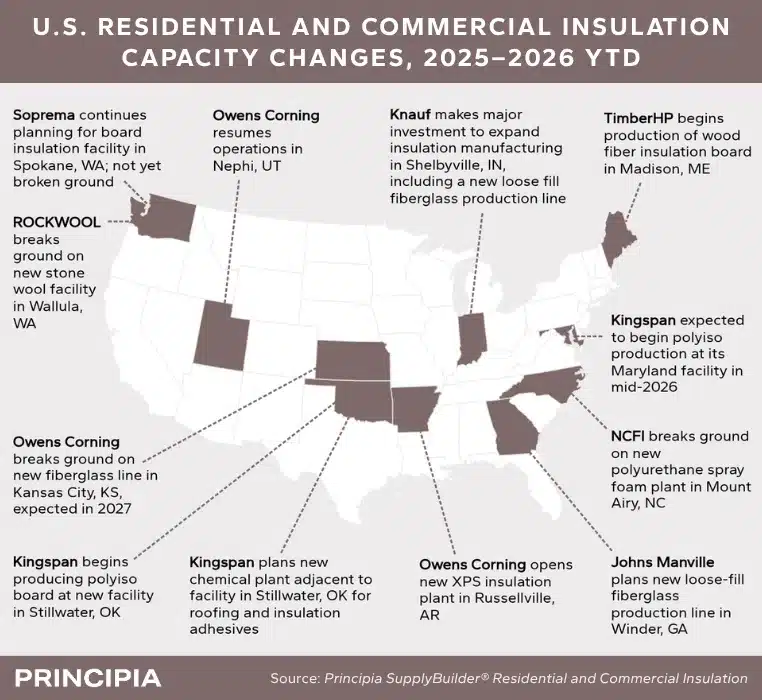
Many of the largest insulation investments announced during 2025 and 2026 have centered on fiberglass. Expansions by Owens Corning, Knauf, and Johns Manville reinforce supplier positions in a category that remains the dominant residential insulation material and a major component of commercial building insulation systems.
The Midwest and South continue to serve as focal points for fiberglass investment activity. New production capacity in Indiana, Kansas, Arkansas, and Georgia strengthens manufacturing networks in regions that represent significant concentrations of construction activity and distribution infrastructure. Owens Corning’s planned reopening of its Nephi, Utah facility in late 2026, alongside new Kansas City fiberglass capacity dedicated to serve commercial insulation applications, further highlights how suppliers are refining manufacturing footprints to serve evolving end market demand. Rather than signaling major disruption, these investments appear aimed at improving operational efficiency, supporting future demand, and reinforcing suppliers’ competitive positions within an established product category.
Given fiberglass insulation’s scale, affordability, and broad applicability, recent capacity additions are likely to support continued market leadership across both new construction and renovation activity
Higher Performance Foam Products Continue to Expand
While fiberglass remains the dominant insulation material, investment activity also highlights growing interest in higher performance foam products.
Kingspan’s polyiso investments and NCFI’s new spray polyurethane foam facility reflect continued demand for insulation systems that deliver higher thermal performance and support increasingly stringent energy efficiency requirements. These products have gained traction in commercial wall and roofing applications where building envelope performance remains a key priority, while continued adoption in residential construction has expanded the addressable market.
As building owners, contractors, and developers place greater emphasis on energy efficiency and lifecycle performance, foam insulation products are positioned to capture incremental share growth over time. For polyiso manufacturers, the commercial roofing market offers an additional advantage: much of demand is tied to repair and replacement activity rather than new construction, providing a measure of resilience during periods of slower building starts.
Alternative Materials Are Building Momentum
Several recent projects also demonstrate growing investment in specialty and alternative insulation materials.
ROCKWOOL’s stone wool expansion in Washington and Soprema’s planned board insulation facility align with increasing demand for noncombustible building materials, particularly in commercial and multifamily construction where fire resistance requirements continue to influence product selection. At the same time, these products continue to gain visibility in select residential applications where performance attributes extend beyond thermal efficiency alone.
Meanwhile, TimberHP’s startup of wood fiber board insulation production in Maine marks one of the more notable developments within emerging insulation categories. Although wood fiber remains a small segment of the U.S. market, interest in sustainable and lower carbon building products is creating opportunities for gradual adoption across both residential and commercial projects.
What This Means for the Market
Recent capacity announcements suggest insulation manufacturers remain confident in the long-term outlook for building envelope demand despite near-term construction headwinds. Most investment activity continues to reinforce established fiberglass and foam product categories, but a growing number of projects are targeting specialty and higher performance materials.
The regional distribution of these investments also highlights where suppliers expect future growth opportunities to emerge. While fiberglass is likely to remain the industry’s foundation, ongoing expansion in polyiso, spray foam, mineral wool, and wood fiber insulation points to a market that is gradually diversifying as energy efficiency requirements, fire performance standards, and sustainability considerations become increasingly important across residential and commercial construction.
Want to understand where insulation demand is headed next? BuilderSeries® Insulation combines construction forecasts, end market intelligence, and supplier activity tracking to help manufacturers identify growth opportunities and monitor emerging competitive shifts across residential and commercial building markets.