Could Water Availability Reshape Construction Growth in the West?
By Casey Olson, Senior Industry Analyst
For more than a decade, Arizona, California, and Nevada have been among the most important drivers of building products demand in the United States. According to Principia DemandBuilder®, combined demand growth in these three states has consistently outpaced the rest of the country, reflecting strong population growth, housing demand, and ongoing construction activity.
That growth may soon face a new challenge.
Recent federal proposals aimed at addressing long-term shortages in the Colorado River Basin would require downstream states to reduce water usage, with Arizona facing the largest proposed cut, followed by Nevada and California. The plan is intended to stabilize water supplies in Lake Mead and Lake Powell after years of drought conditions, increasing demand, and declining reservoir levels.
While the immediate focus is on water management, the implications extend well beyond utilities and agriculture. For the construction industry, the bigger question is whether water availability could become a growing constraint on future development.
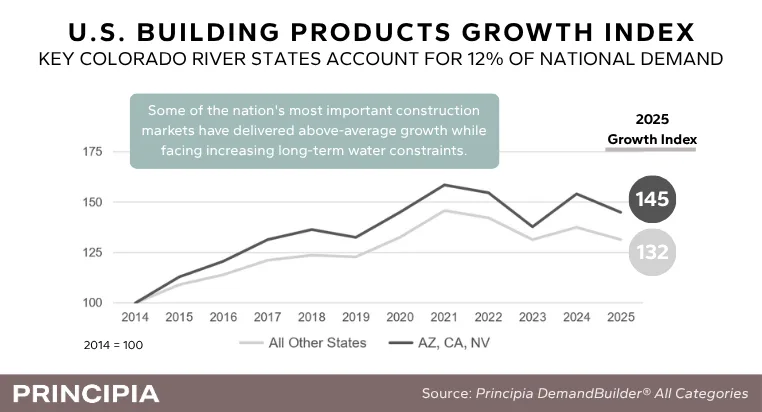
Combined the three key Colorado River states facing new water constraints account for 12% of the nation’s demand for building products. As shown in the chart, product demand volume in Arizona, California, and Nevada reached a growth index of 145 by 2025, compared to 132 for all other states combined. In other words, construction activity in these Colorado River-dependent states has expanded more rapidly than the national average over the last decade.
These markets have benefited from strong demographic trends, business investment, and residential development. From large master-planned communities in Arizona to continued housing demand across California and Nevada, the region has remained an important source of growth for manufacturers serving the residential construction market.
Water Could Impact Growth
Demand for housing is unlikely to disappear. However, water availability increasingly influences how quickly new communities can be developed and approved.
Many municipalities in the West already require developers to demonstrate long-term water availability before new projects can move forward. As water supplies become more constrained, communities may place greater emphasis on conservation measures, water-efficient infrastructure, reuse programs, and growth management policies.
This does not necessarily mean less construction. Instead, it may mean longer development timelines, higher infrastructure costs, and greater scrutiny of large-scale residential projects.
What This Means for the Market
The Colorado River proposal highlights an emerging consideration for long-term construction forecasting: resource availability.
Historically, conversations about housing growth have focused on demographics, affordability, labor availability, and interest rates. Increasingly, infrastructure capacity and water access may also influence where future development occurs and how rapidly high-growth regions can expand.
For building product manufacturers, the takeaway is clear. Some of the nation’s strongest construction markets continue to generate above-average demand growth, but understanding the factors that could shape future development capacity will become increasingly important. Water availability will likely play a larger role in determining where that demand can ultimately be built.
DemandBuilder® helps manufacturers track demand trends, regional growth patterns, and emerging market risks to identify where future construction activity is likely to occur and where growth constraints may begin to emerge.