A New Labor Playbook for Roofing Contractors
By Lilli Tillman Smith, Roofing Industry Analyst
A shift in federal worker classification standards could benefit roofing contractors that rely on subcontracted installation crews. However, persistent labor shortages and immigration uncertainty will continue to challenge the industry’s ability to expand installation capacity.
The U.S. Department of Labor (DOL) announced November 19, 2026, that it is rescinding the Biden administration’s 2024 independent contractor rule and returning to a framework resembling the approach adopted during President Trump’s first administration.
For roofing contractors, particularly those operating in the commercial market, the change could make it easier to engage independent subcontractors and manage project-based labor requirements. The timing is notable as contractors continue to face workforce shortages, rising labor expenses and uncertainty surrounding immigration policy.
What Is Changing?
The new rule reinstates the standard used to determine whether workers are classified as employees or independent contractors under the Fair Labor Standards Act.
The framework places primary emphasis on two factors:
- Control over work: Whether workers independently determine schedules, working methods and work arrangements
- Opportunity for profit or loss: Whether workers can influence financial outcomes through business decisions, investments and independent management
For roofing contractors, this distinction is particularly relevant when engaging installation crews. An established subcontractor that negotiates project pricing, supplies equipment, manages employees and works with multiple contractors generally demonstrates the characteristics of an independent business.
The revised framework provides a more favorable environment for these arrangements, although contractors must still demonstrate genuine business independence. State employment laws and IRS classification requirements remain applicable.
Source: U.S. Department of Labor
A Positive Development for Roofing Contractors?
Generally, yes.
Roofing is particularly well suited to project-based labor arrangements. Contractors frequently need to expand installation capacity when projects are awarded and scale back when workloads decline.
A more favorable independent contractor standard could provide several benefits:
- Greater workforce flexibility: Easier engagement of independent installation businesses
- Cost management: Potential reductions in certain payroll-related expenses and administrative obligations
- Improved scalability: Greater ability to pursue large projects without proportionately increasing permanent headcount
- Competitive advantages: Contractors with established subcontractor networks may be better positioned to manage fluctuating demand
Commercial roofing contractors could see particularly meaningful benefits given their reliance on specialized installation crews.
Will This Help Solve the Roofing Labor Shortage?
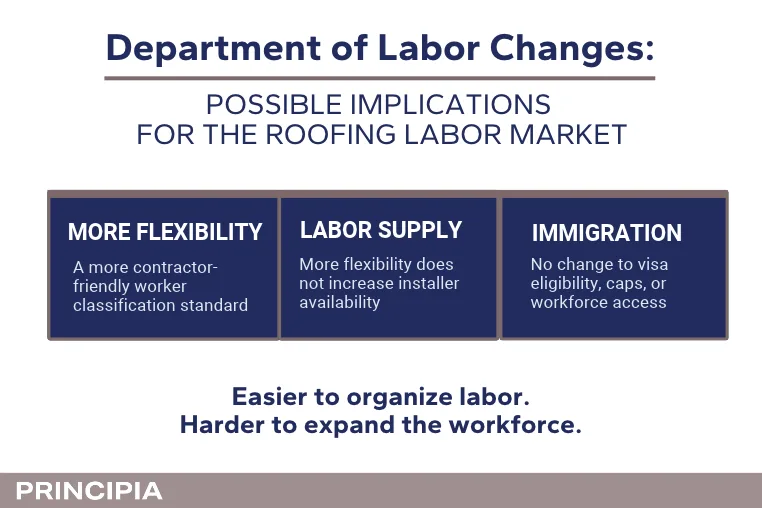
The rule could make it easier for contractors to organize existing labor, but it does little to address the underlying shortage of qualified installers.
According to the Home Builders Institute’s Fall 2025 Construction Labor Market Report, skilled labor shortages cost the residential construction industry approximately $10.8 billion annually through higher carrying costs and lost production. The report also estimates that immigrants account for 25.5% of residential construction employment.
Greater subcontracting flexibility could help contractors distribute available workers across projects more efficiently. However, increased competition for established installation crews could also put upward pressure on subcontractor pricing.
The likely outcome is improved labor flexibility rather than a meaningful increase in labor availability.
Source: Home Builders Institute
Immigration Could Have a Bigger Impact
Foreign-born workers represent a substantial portion of the construction workforce, making immigration policy an important consideration for roofing contractors.
One relevant program is the H-2B visa, which allows U.S. employers to temporarily hire foreign workers for nonagricultural jobs when qualified domestic workers are unavailable.
For FY2026, the administration authorized up to 64,716 additional H-2B visas beyond the regular annual allocation of 66,000.
However, the program has limitations, including employer sponsorship requirements, temporary workforce needs and annual visa caps.
The new DOL rule does not change visa eligibility, immigration enforcement or employment authorization requirements. Classifying someone as an independent contractor does not provide immigration authorization.
This creates an important distinction: roofing contractors may gain flexibility in how they organize their workforce while still facing significant constraints on the number of workers available.
Sources: USCIS H-2B Visa Program; USCIS H-2B Cap Information
What This Means for the Roofing Market
The interaction between worker classification, immigration policy and labor availability will be important to monitor.
The revised DOL framework could help contractors manage labor expenses and installation capacity more efficiently. However, continued shortages of experienced installers and tighter immigration constraints could offset some of those benefits.
For roofing manufacturers, installation capacity is an important component of project execution and material demand. Labor shortages can delay projects even when material availability and customer demand remain healthy.
Over the next year, four developments will be worth watching:
- Subcontracting activity: Whether larger commercial roofing contractors increase their reliance on independent installation businesses
- Installation pricing: Whether greater workforce flexibility moderates labor cost increases or competition for experienced crews continues pushing subcontractor pricing higher
- Immigration enforcement: Whether workforce disruptions affect contractor capacity and project timelines
- H-2B utilization: Whether roofing contractors increasingly pursue temporary foreign workers to address seasonal labor requirements
The DOL’s revised independent contractor standard is generally favorable for roofing contractors, particularly those with established subcontracting networks. However, the rule does little to address the industry’s fundamental labor shortage.
Roofing contractors may have more flexibility in how they source and organize labor, but the availability of qualified installers remains the bigger constraint. Immigration policy and access to foreign-born workers could ultimately have a greater influence on installation capacity, labor costs and the industry’s ability to meet future demand.
Want deeper visibility into roofing demand trends? BuilderSeries Roofing delivers monthly residential and commercial roofing market data, forecasts, and leading indicators that help manufacturers monitor market conditions, identify emerging opportunities, and make more informed planning decisions. Learn more about BuilderSeries Roofing from Principia Consulting.